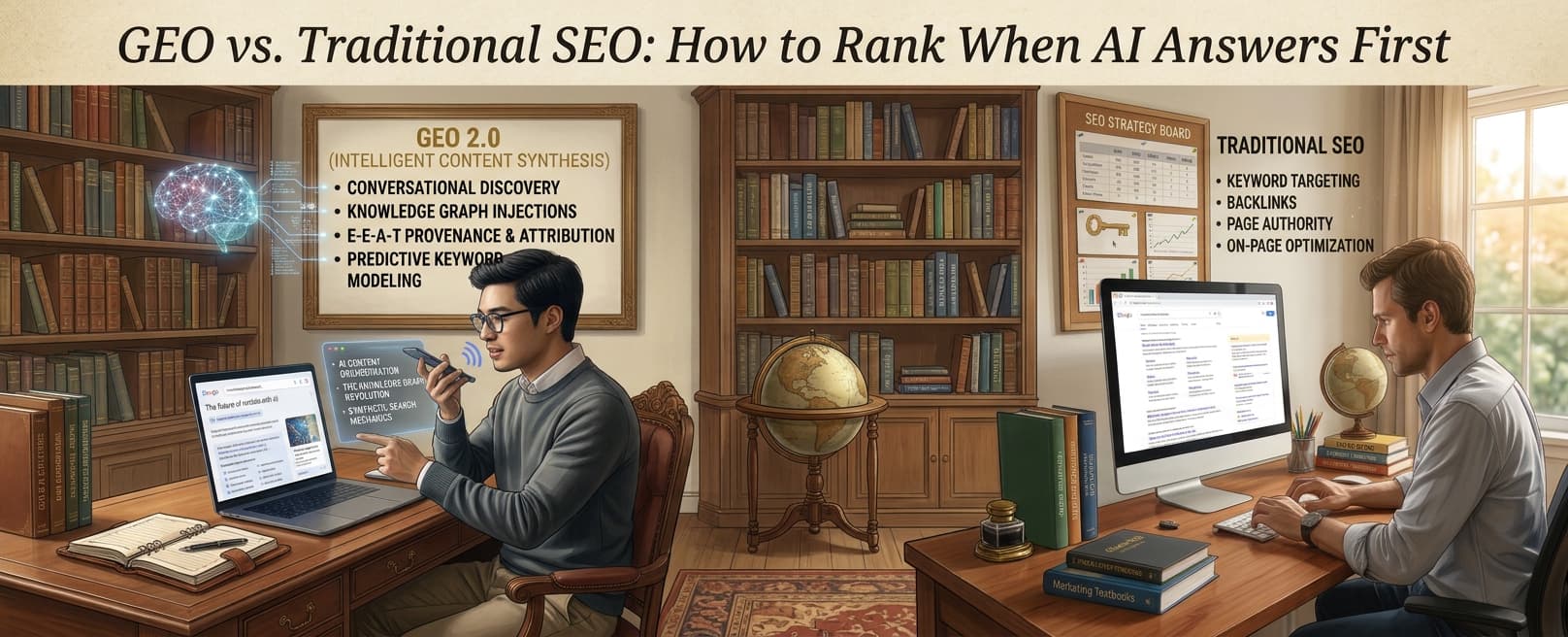
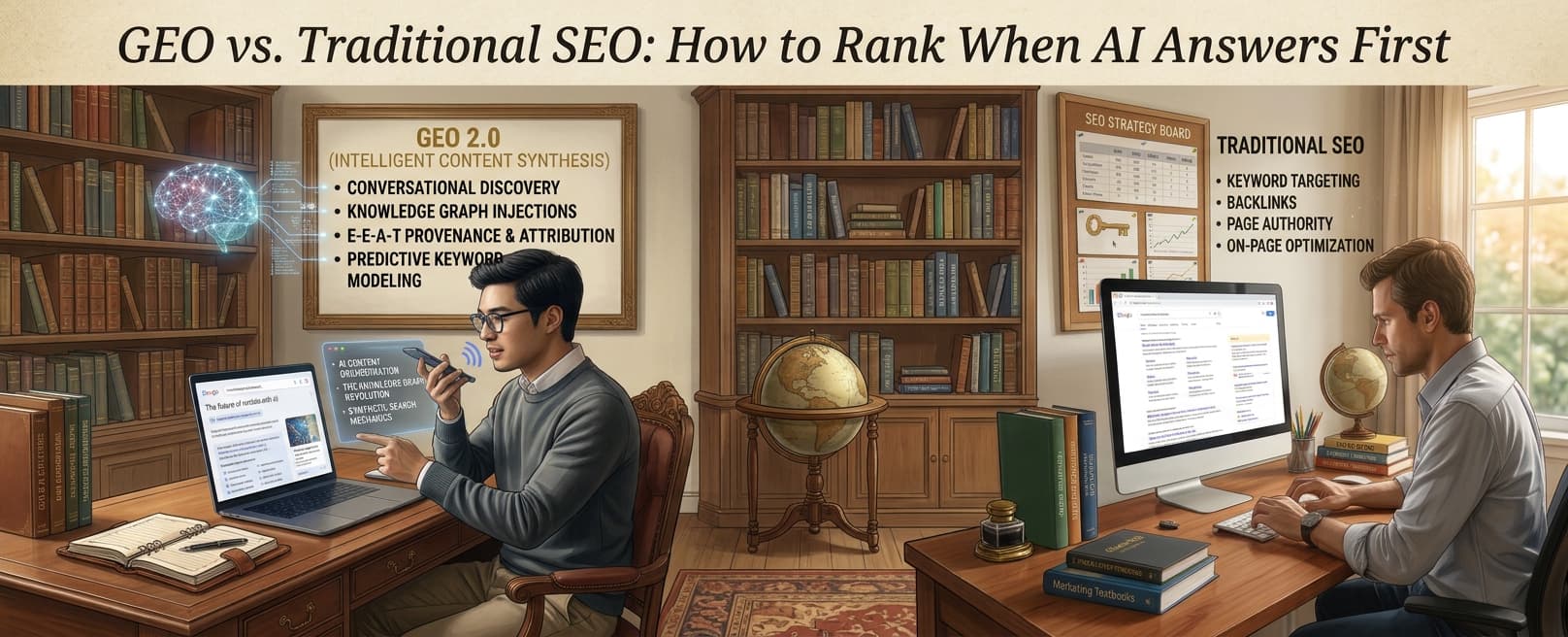
Google search results used to be a simple competition for ten blue links. If you provided the best content and had the most authority, you climbed the list. That system is breaking. With the rise of AI-generated summaries, users often find their answers without ever clicking a website. This shift has created a split in digital strategy: GEO vs. Traditional SEO.
One focuses on winning the click; the other focuses on being the source the AI cites. When you look at the current search landscape, the conflict between GEO vs. Traditional SEO is not about which one is better. It is about which one matches the specific way your audience asks questions. If they want a quick fact, you need GEO. If they want to buy a specialized product, traditional SEO still holds the keys.
The criteria for choosing your strategy
Before we look at specific tools or tactics, we have to establish how we judge success in this new environment. Not every business needs to chase every AI trend. We are evaluating these strategies based on four specific factors:
Citation Probability: The likelihood that an AI engine will name your brand as the source of its information.
Conversion Friction: How many steps a user must take from seeing your name to making a purchase.
Technical Cost: The time and money required to maintain the site structure needed for visibility.
Traffic Longevity: How long a single piece of content remains relevant and discoverable.
Traditional search is becoming a destination for deep research and transactions. AI search is for everything else.If your top-performing pages are answering "what is" questions, you are already losing traffic to AI overviews.
The core differences in GEO vs. Traditional SEO
Traditional SEO is built on the foundation of keywords and backlinks. You optimize for a crawler. In contrast, Generative Engine Optimization (GEO) is about optimizing for a learner. An LLM (Large Language Model) does not just look for words; it looks for the most statistically probable, accurate answer to a prompt.
The biggest separator is the target. Traditional methods target the Googlebot. GEO targets the "embedding space" of a model like GPT-4 or Gemini. This means that while 1,500-word blog posts used to be the gold standard, an AI might prefer a 200-word table that is easier to parse and synthesize.
The following table breaks down the technical and strategic differences between these two approaches:
Feature | Traditional SEO | Generative Engine Optimization (GEO) |
|---|
Primary Goal | Rank #1 on Google SERP | Become a cited source in AI answers |
Success Metric | Click-Through Rate (CTR) | Citation Frequency / Brand Mentions |
Content Style | Keyword-focused, long-form | Factual, authoritative, modular |
Link Strategy | Domain Authority / PageRank | Relevance and context-rich citations |
User Intent | Navigational and Transactional | Informational and Comparative |
GEO vs. Traditional SEO is a battle between being the destination and being the data. If you can't be both, you have to decide where your revenue actually comes from. For many, What is GEO (Generative Engine Optimization) and Why Your Business Needs It Now is the first question they ask when they see their organic traffic dipping by 30% month-over-month.
How AI overviews content strategy changes the game
Zero-click search results are the primary threat to the old way of doing things. When Google provides a full answer at the top of the page, the "Traditional" part of the GEO vs. Traditional SEO equation loses its value for informational queries. To win here, your content must be citable. This means using "authoritative" language—avoiding fluff and sticking to verifiable claims.
Specific AI search ranking factors include the use of statistics, direct quotes, and structured data. If your page contains a unique data point, an AI engine is more likely to pull it. This is why many companies are shifting their SEO Strategies for 2026: How to Rank Higher on Google to focus on primary research. You cannot be "summarized" out of existence if you are the only one with the raw data.
Consider the difference in how you would write about a software comparison. In a traditional world, you might write a long review. In the world of GEO vs. Traditional SEO, you would provide a clear, schema-marked table of features. The AI can read that table in milliseconds and use it to answer a prompt like "Which software is cheapest for a team of ten?"
The role of Large Language Model search visibility
Visibility in models like Perplexity or ChatGPT Search requires a different technical stack. AI engines do not crawl the web in the same way Google’s traditional indexer does. They are looking for patterns. If you use a complex JavaScript framework that hides your content behind multiple loads, you might hurt your large language model search visibility.
For instance, when comparing Flutter vs. React Native: Which Framework is Best in 2026, the technical way you present that comparison matters. If the information is buried in a heavy dynamic site, the LLM may fail to scrape the nuances. This leads to the "static vs. dynamic" debate. While dynamic sites offer more features, Static vs. Dynamic Websites: Which One is Right for Your Business? often comes down to how easily an AI can digest your core information.
A clean, fast-loading HTML structure is the bridge between GEO vs. Traditional SEO. It serves the traditional crawler while making the AI's job easier. If the AI has to work too hard to find your facts, it will just use your competitor's site instead.
Who should double down on Traditional SEO?
Despite the hype, GEO is not the right move for everyone. If you run a local business—like a locksmith in Chicago or a dentist in London—your GEO vs. Traditional SEO split should lean heavily toward the traditional side. AI answers are notoriously bad at local intent. They often hallucinate addresses or recommend businesses that closed three years ago.
Traditional SEO still wins for:
Local Services: Google Maps and the "Local Pack" remain the primary way people find immediate help.
High-Intent E-commerce: People still want to see a product page, read user reviews, and see high-res photos before they buy.
Niche Communities: Forums and community-driven sites rely on human interaction that AI cannot replicate.
If you are selling a $5,000 enterprise software solution, a summary by an AI is rarely enough to close a deal. You need the user to land on your site, engage with your whitepapers, and enter your sales funnel. In this specific GEO vs. Traditional SEO scenario, the AI summary is just a billboard; the website is the showroom.
Who should pivot to Answer Engine Optimization?
Answer engine optimization is the path for anyone whose business relies on "top of funnel" awareness. If you are a media site, a blogger, or a SaaS company providing general industry advice, you have no choice. The traditional "how-to" article is dying. People are asking their phones or their AI apps directly.
You have to optimize for the AI Overview or accept that your traffic will drop to near zero. This involves using "Citation-Mining" techniques: making sure your brand name is mentioned in close proximity to the keywords you want to be associated with across the entire web, not just on your own site.
Anyway, here is the part most people miss. GEO is not just about your site. It is about your brand's presence on Reddit, Quora, and industry news sites. AI models train on these platforms. If people on Reddit are talking about your product as the best solution for a specific problem, the AI will learn that. GEO is basically PR for robots.
The technical overhead of GEO vs. Traditional SEO
Maintaining a dual strategy is expensive. You need the technical SEO basics: fast load times, mobile responsiveness, and clean URL structures. But for GEO, you also need to implement advanced Schema.org markup. This tells the AI exactly what each piece of data represents.
If you compare the resource allocation for GEO vs. Traditional SEO, the traditional side requires more "active" maintenance like link building. The GEO side requires more "passive" authority building. You have to ensure that your facts are consistent across the web. If your site says one thing and your LinkedIn or Wikipedia page says another, the AI will flag the inconsistency and likely ignore both.
The technical divide in GEO vs. Traditional SEO becomes clear when you look at how bots parse data. A traditional bot looks for <h1> tags. An AI bot looks for the semantic relationship between your <h1> and the surrounding <p> tags. It is looking for context, not just structure.
Worked Example: The "Best Coffee Maker" Query
Let's look at how a content piece would differ. In a Traditional SEO approach, you would write: "The 10 Best Coffee Makers of 2025." You would include 2,000 words of text, some Amazon affiliate links, and a lot of adjectives like "stunning" or "remarkable" (which, by the way, I’m told to avoid because they sound like a robot, but humans use them too). You hope to rank #1.
In a GEO approach, you would prioritize a "Key Specifications" section at the very top. You would use bullet points with exact numbers (15-bar pressure, 1.5-liter tank). You would include a section called "Why this is the best for small kitchens." The AI will see that specific claim, verify it against other sites, and then cite you when a user asks, "What's the best small coffee maker?"
The GEO vs. Traditional SEO winner here is the site that gives the AI the easiest sentence to steal. It sounds cynical, but that is the reality of the answer engine era. You are providing the ingredients for someone else's meal.
Is there a middle ground?
Most successful sites in the next two years will not choose one. They will use a hybrid model. This means keeping the long-form content that satisfies the traditional Google algorithm while adding "AI-friendly" modules to every page. These modules are essentially summaries of the page's core facts, designed to be easily ingested by an LLM.
The GEO vs. Traditional SEO balance is about 70/30 for most. 70% of your effort should go into the traditional tactics that still drive 90% of your revenue. 30% should go into GEO experiments to ensure you aren't left behind as AI overviews become the default. It is about hedging your bets.
OK so, the real challenge is measurement. We have Google Search Console for traditional metrics. We have almost nothing for GEO. You have to look at "brand mentions" and "unlinked citations" as your new KPIs. If your traffic from "Direct" or "Other" sources starts to climb while your "Organic Search" drops, it might be a sign that people are finding you through AI and then typing your URL directly.
The final verdict on GEO vs. Traditional SEO
The choice between GEO vs. Traditional SEO comes down to your business model. If you are a "middleman" of information—someone who summarizes what others do—GEO is your primary threat and your only hope. You must become the most authoritative summarizer in the eyes of the AI. If you are a "doer"—someone who provides a service or a physical product—traditional SEO is still your bread and butter.
Do not throw away your keyword research spreadsheets just yet. But do start thinking about how a machine would describe your business if it only had 50 words to do it. That 50-word summary is the future of your visibility. The GEO vs. Traditional SEO debate will eventually just become "SEO," but for now, the distinction is what allows you to prioritize your limited marketing budget.
For what it's worth, the most dangerous thing you can do is ignore the change. The transition to AI-first search is happening faster than the transition to mobile did in the 2010s. If you aren't visible in the AI overview, you are effectively invisible to a growing segment of the population that no longer scrolls past the first result.
Frequently Asked Questions
Does GEO mean I should stop focusing on long-form content?
No, because long-form content is still what builds the topical authority that AI engines look for. However, you should add clear, modular summaries or data tables to that long-form content so the AI can easily extract the core facts without reading the whole page.
How do I know if my site is being used by AI engines?
You can check your server logs for user agents associated with AI crawlers like OAI-SearchBot or PerplexityBot. Additionally, perform manual searches for your core topics in ChatGPT or Gemini and see if your site is listed in the 'Sources' or 'Citations' section.
Will GEO techniques hurt my traditional search rankings?
Generally, no. Most GEO techniques—like using structured data, clear headings, and factual language—are also considered best practices for traditional SEO. The only risk is if you make your content so dry and robotic that human users stop engaging with it, which could hurt your traditional dwell-time metrics.
Can I rank in AI overviews without high domain authority?
Yes, more easily than in traditional search. AI engines often prioritize the 'best' answer or the most relevant data point over the site with the most backlinks. This gives smaller, niche sites a chance to outrank massive competitors if they provide more specific, verifiable information.
Is GEO only relevant for Google Gemini?
No, GEO applies to any platform that uses an LLM to generate answers, including Perplexity, Bing Chat, and even the new search features in social media platforms. Each has slightly different ranking factors, but all reward factual density and clear structure.