The click is disappearing, and nobody agreed to that
The blue link is dying, and it's dying faster than most marketing teams have noticed. When Google shows an AI Overview above the regular results, organic click-through on informational queries falls from 1.76% to 0.61% — a 61% drop, according to Seer Interactive. That's not a slow decline you can plan around over a few quarters. That's a cliff.
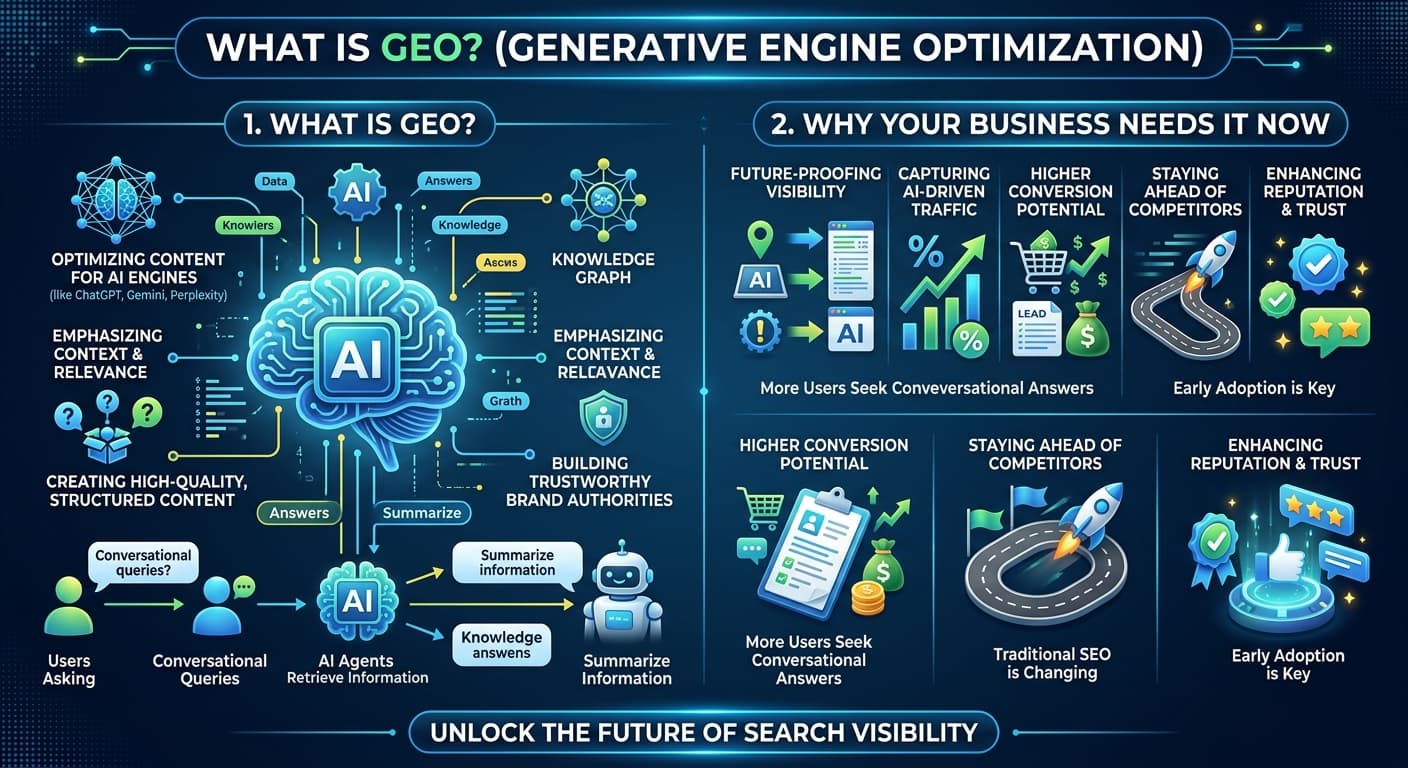
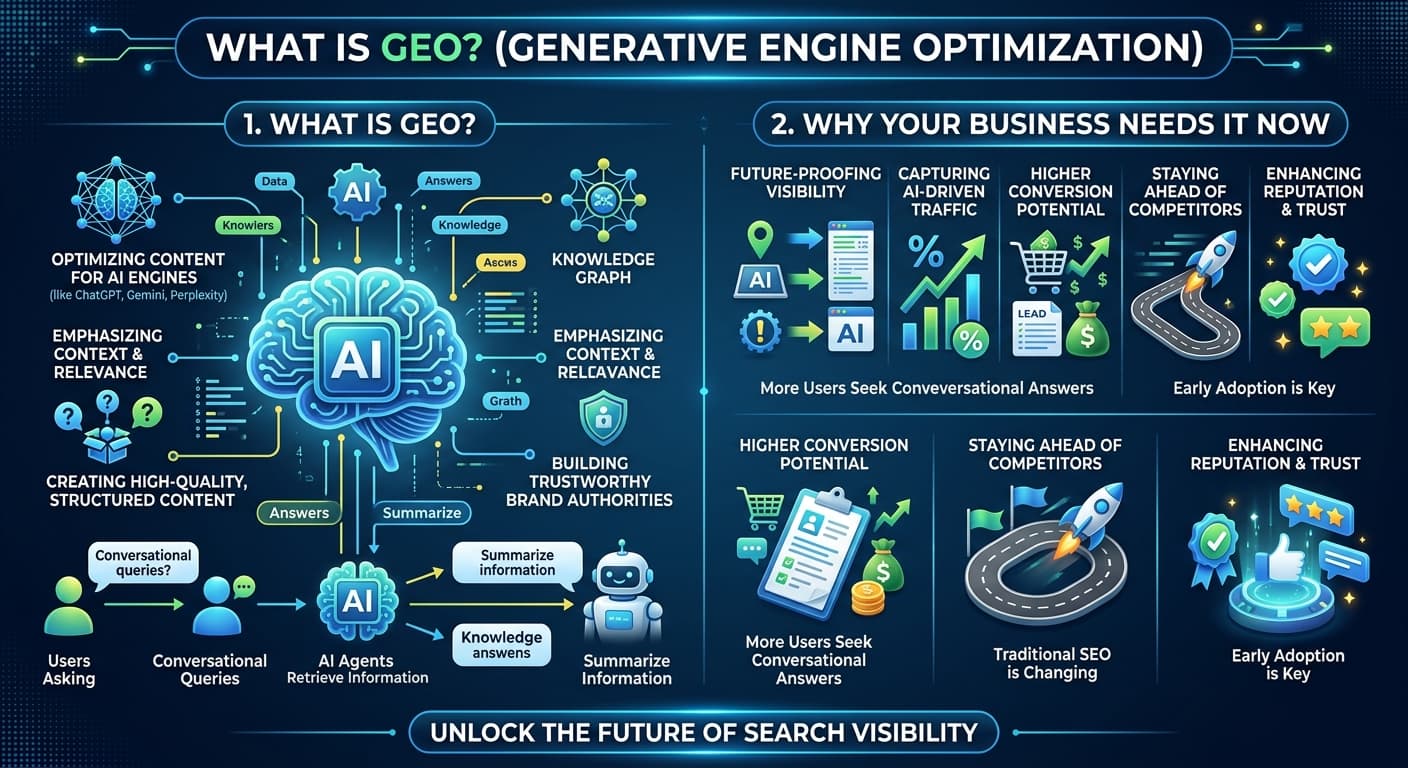
That single number is the entire argument for generative engine optimization. If people are getting their answer from ChatGPT, Gemini, Perplexity, or an AI Overview and never clicking through to a website, then ranking first in classic search results stops mattering nearly as much as being the source the AI model chooses to quote, summarize, or recommend.
What generative engine optimization actually means
Generative engine optimization is the practice of getting your business mentioned, cited, or recommended inside the answers that large language models generate, rather than getting a page ranked in a results list. It sits next to SEO for AI chatbots and answer engine optimization as roughly the same idea described by different people, but the core shift is the same everywhere: the unit of success is no longer a rank position, it's a sentence with your brand name in it.
This is not the same skill set as classic keyword targeting, even though it uses some of the same infrastructure. A page still needs to be crawlable. It still needs clean HTML, fast load times, and a sitemap that doesn't lie about what's on the page. But an AI model isn't scoring your page against 200 ranking factors — it's pulling a chunk of text that answers a specific question cleanly, and deciding whether that chunk deserves to be quoted.
SEO and GEO side by side
Dimension | Traditional SEO | Generative engine optimization |
|---|
Success metric | Rank position, organic click-through | Citation frequency, share of voice inside AI answers |
Content shape | Long-form pages built around keyword clusters | Direct, quotable answers near the top of the page |
Update cadence | Refresh occasionally to defend rank | Frequent updates matter more than original publish date |
Authority signal | Backlinks and domain authority | Mentions on Reddit, G2, forums, and press coverage |
Where you're judged | Google, Bing search results pages | ChatGPT, Gemini, Copilot, Perplexity, AI Overviews |
Will generative engine optimization replace SEO, or just sit next to it?
Neither answer people give is quite right. It won't replace SEO, because every AI answer engine still needs a crawlable, well-marked-up web to draw from — schema markup, clean headers, a server that responds fast are still doing work underneath the surface. But treating GEO as a bolt-on to your existing SEO checklist undersells it too. The two disciplines now compete for the same budget and the same content team, and generative engine optimization is winning a growing share of both.
Here's the part that trips people up: a page can rank on page one of Google and never once get quoted by an AI model, because the model isn't reading the page the way a person scanning results does. It's extracting a specific claim. If your best answer is buried in paragraph six under three paragraphs of throat-clearing, it doesn't matter how well the page ranks.
How the model decides whose answer to trust
Freshness turns out to matter a lot more than most content calendars assume. In an analysis of 4,124 pages cited across LLM answers, 72% had been updated within the past year, while only 42% were originally published that recently — meaning the pages doing the citing work aren't necessarily new, they're maintained, according to Seer Interactive. A five-year-old page with a recent edit date can out-cite a brand-new one that nobody's touched since launch.
Brand authority off the page counts for just as much as the page itself. Models trained and retrieved on a wide slice of the open web pick up what's said about you on G2, on Reddit threads, in trade press, in comparison articles you didn't write. This is the part of generative engine optimization that looks less like content strategy and more like digital PR and reputation management, and businesses that treat it purely as an on-page exercise usually stall out.
Nobody's written the playbook for when the AI gets you wrong
Here's a problem the existing guides mostly skip: what happens when ChatGPT confidently tells someone your return policy is 90 days when it's actually 30, or names a competitor as the market leader in your category when the data doesn't support that. This happens more than people expect, and there's no support ticket you file with OpenAI to fix it.
The practical response, for now, looks like this:
Run your own brand-name prompts regularly across the major models and log exactly what's claimed, not just whether you're mentioned.
Publish a clear, structured, unambiguous statement of the fact being misrepresented — pricing, policy, certification — somewhere the model is likely to re-crawl, since models lean on recently updated, directly worded sources.
Correct the record on the third-party platforms feeding the model, not just your own site, since a Reddit thread or a G2 review often carries more weight in retrieval than your homepage does.
None of this is fast, and none of it is guaranteed. There's no standardized way yet to force a correction into a model's next output, and that's worth saying plainly rather than pretending some agency has cracked it.
Measuring something that doesn't have a dashboard yet
Ask five agencies how to track AI Share of Voice and you'll get five different spreadsheets. The closest thing to an agreed method comes from running a batch of realistic buyer prompts — Deloitte frames a baseline audit as testing 50 to 100 of these across ChatGPT, Copilot, Gemini, and Perplexity, and scoring brand sentiment and citation presence each time. You do it once for a baseline, then again monthly, because model behavior shifts with every retrain and every product update.
What almost nobody has solved is the harder question sitting underneath that: how much revenue actually came from an AI citation. A person who reads your brand recommended inside a Perplexity answer, then searches your name directly, then converts three weeks later on a completely different channel, leaves no clean line back to that citation. Marketing attribution models built for click paths don't have a slot for "the model mentioned us and nobody clicked anything." Anyone who tells you they've fully solved AI-citation attribution is selling something.
Should you bother with llms.txt?
You've probably seen llms.txt mentioned as the robots.txt of the AI era — a plain-text file at the root of your domain, meant to tell language models what to prioritize when reading your site. It's a reasonable idea. It's also unproven: there's no agreed spec every model actually respects, no published benchmark showing it changes citation rates, and no guarantee the major labs are reading it at all yet.
Put it on the list, but put it near the bottom. Structured data, clean headers, and direct answers on the page itself are doing measurable work today. An llms.txt file is a bet on a convention that might matter in eighteen months. Worth having someone spend an afternoon on it. Not worth delaying a real content rework to build it first.
Where to actually start this week
Skip the twelve-month roadmap. Start with the audit, because everything after it depends on what you find.
Write down 50 real questions your buyers ask, in their own words, not your marketing copy's words.
Run each one through ChatGPT, Gemini, Copilot, and Perplexity, and note whether you're mentioned, how you're described, and who's mentioned instead of you.
Pick your ten worst-performing pages by traffic and rewrite the opening two sentences to answer the core question directly, before any brand throat-clearing.
Update the publish date and the actual content on your five oldest high-value pages this month, not next quarter.
Check what G2, Reddit, and any trade press are currently saying about you, since that's feeding the model whether you've noticed or not.
The businesses winning early citations aren't the ones with the biggest content teams — they're the ones who rewrote their existing pages to answer the actual question in the first two sentences.
Somewhere in the next year, someone is going to build the attribution model that ties an AI citation to a closed deal, and whoever ships it first is going to own this conversation. Until then, you're optimizing against a moving target with an incomplete instrument panel, and the honest move is to say so instead of pretending the dashboard already exists.
Common questions about generative engine optimization
What is the main difference between SEO and Generative Engine Optimization?
Traditional SEO earns a ranked position in a list of links a person then clicks through. Generative engine optimization earns a citation or a direct mention inside an AI-generated answer, where the person often never clicks anywhere at all. The mechanics overlap heavily, but the finish line has moved.
How do AI search engines decide which sources to cite in their answers?
They weigh content freshness, how clearly a page answers a specific question, and how often a brand is mentioned favorably across the open web, including forums and review sites. An analysis of 4,124 cited pages found 72% had been updated within the past year, well above the 42% that were originally published that recently, which points to freshness mattering more than first-mover advantage.
Will Generative Engine Optimization replace traditional SEO?
No, and treating it as a replacement is the most common mistake teams make. AI answer engines still rely on crawlable, well-structured, technically sound pages, which is SEO's job. Generative engine optimization sits on top of that foundation rather than instead of it.
How do you track and measure brand visibility across AI chatbots and answer engines?
Run a batch of realistic buyer prompts, typically 50 to 100, across ChatGPT, Copilot, Gemini, and Perplexity, and log whether your brand appears, how it's described, and whether competitors show up instead. Repeat this on a schedule rather than once, since model outputs shift with every update and there's no stable dashboard yet that does this for you automatically.