The Client & The Context
An embassy interview lasts a few minutes and can decide years of someone's life. Applicants prepare for it the way people prepare for anything terrifying and unfamiliar — by asking friends who've been through it, watching videos of strangers, and guessing at what "confident" is supposed to sound like.
Intertricks came to us with a clear thesis: this preparation could be structured, practised, and measured. Applicants could rehearse real interview questions — by text and on video — and receive a scored assessment of how they did. And the consultancies who already advise these applicants could offer the same preparation as part of their service.
[VERIFY: client's stage — was there an earlier version, or did we build v1? One line here grounds the story.]
The Challenge
- The AI has to be useful without being trusted blindly — an applicant wrongly told they're ready walks into an embassy over-confident, so any AI assessment had to be accompanied by an honest route to human judgement.
- Video is heavy, and transcription is the bottleneck — recorded answers need to be captured, stored, transcribed, and scored reliably on ordinary consumer connections, without the applicant waiting around wondering whether it worked.
- Two audiences, one platform — individual applicants want practice and progress, agencies want oversight across a whole roster, and building each properly without the interfaces colliding is a product design problem before it's an engineering one.
- Results have to be verifiable — a score is worth little if anyone can screenshot and edit it, so verification had to be built into the artefact itself.
Our Approach
We designed the AI as one path through the system rather than the whole system: transcription and scoring run as separate stages, so the pipeline stays debuggable — you can see exactly what the model "heard" before you question what it concluded — and each stage can be improved independently.
Human review was built as a first-class feature, not a complaint channel. Applicants can request a human review of the same attempt at any time. This is the design decision that makes the AI honest — the product never has to pretend the model is infallible, because the alternative is one click away, built into the flow rather than bolted on as a support ticket.
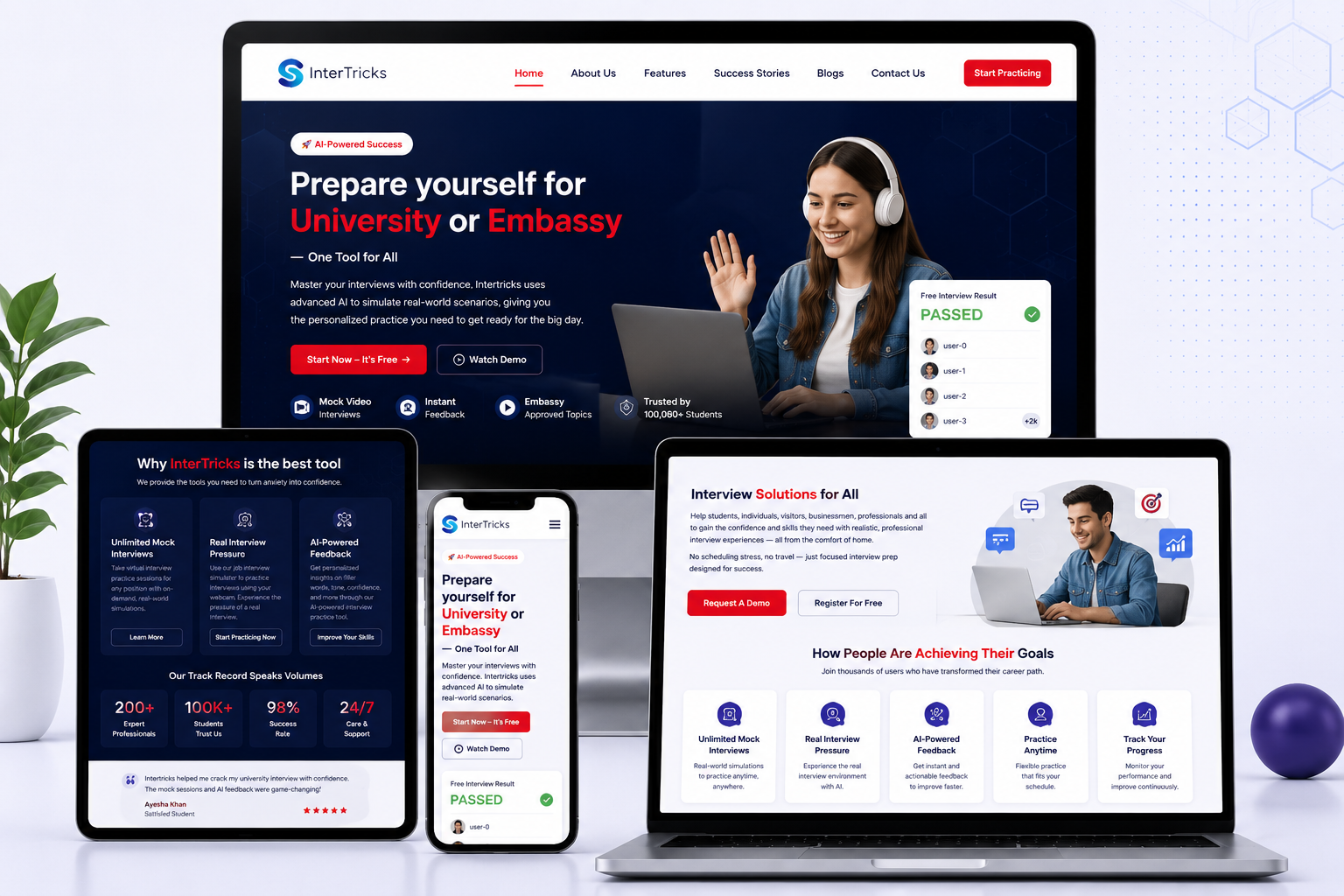
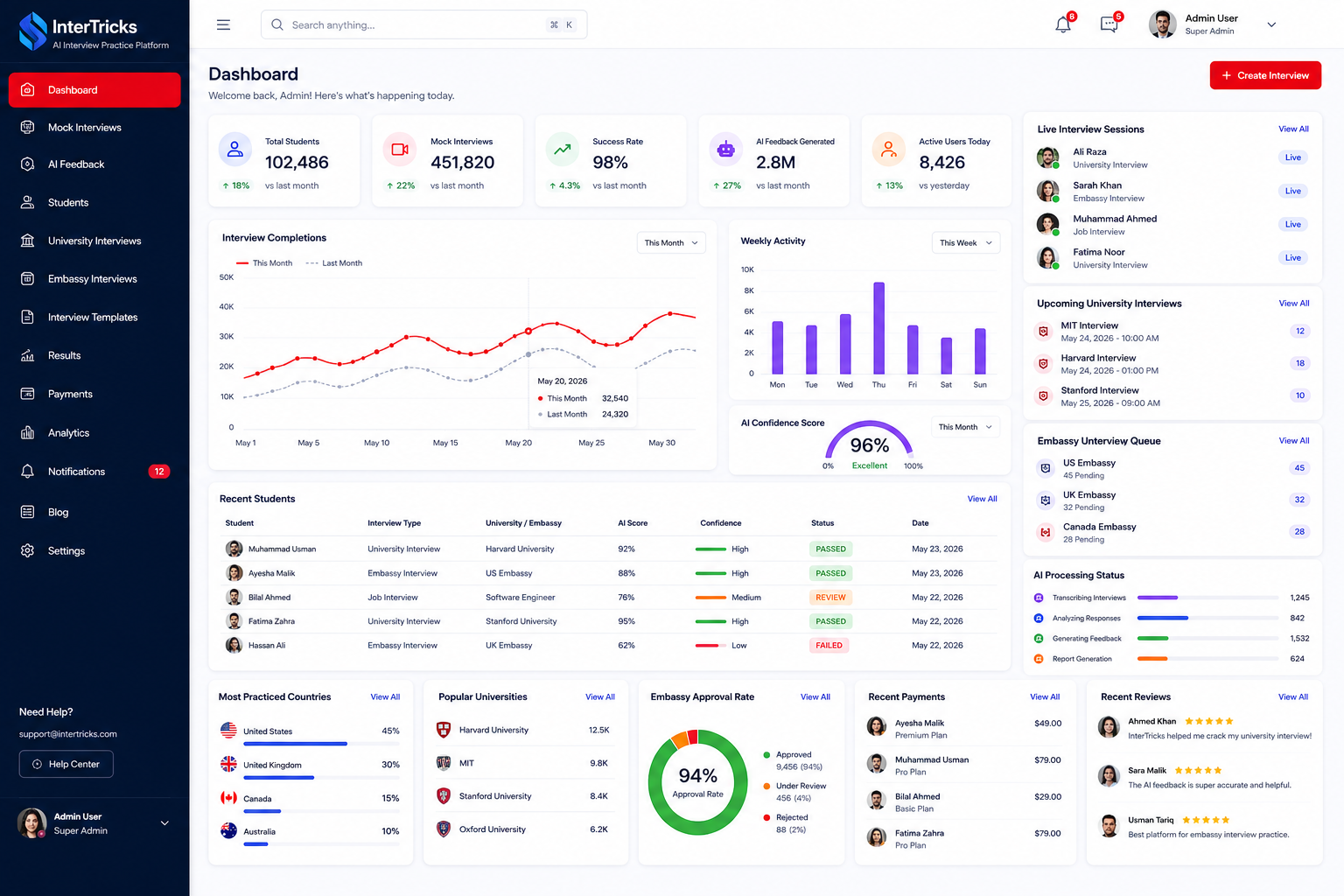
Applicants and agencies got deliberately separate surfaces on the same platform and the same data model: applicants get practice, history, and progress; agencies get a dashboard built around a roster — register, add students, assign, monitor, review results.
What We Built
The applicant experience runs on Next.js: choose a practice set, answer by text or by recording video, submit, and receive a scored breakdown with the transcription visible. Every attempt is retained, so an applicant can see their trajectory across sessions rather than a single score in isolation — which is what actually builds the confidence the product is selling.
The agency layer sits on the same foundation. A consultancy registers, adds its students, assigns tests, and watches results arrive in one place — replacing spreadsheets and WhatsApp follow-ups with a system. Around both sits the commercial machinery: packages, an integrated payment gateway, and a rewards and referral programme, because in this market applicants find their preparation through people who've already used it.
Each result also carries a QR code that resolves to a verification page on the platform, so a consultancy can scan it and confirm the result is real — turning a score into a credential.
[FILL: number of question sets / interview types covered — a concrete number makes the platform feel substantial.]
Technical Decisions (and the Trade-offs)
- GPT for transcription, with the transcript exposed to the user — showing the applicant what was transcribed before showing the score is the trust mechanism: when a score seems unfair, the user can see whether the system misheard them, since misheard audio is a far more common cause of a strange score than bad scoring logic.
- Human review on request, not automatic escalation — we considered automatically routing low-confidence assessments to humans, but chose user-initiated review instead, because the applicant is the best judge of when a machine opinion isn't enough for a decision this important. The trade-off is that some applicants will accept a weak AI score without asking for review; the mitigation is making the option visible at exactly the moment the score appears.
- Node back-end with a queue-based media pipeline — video upload, transcription, and scoring don't happen inside a request cycle, so applicants on ordinary connections submit and get on with their day. [VERIFY: confirm the queue/processing approach before publishing.]
- QR verification against a live record, not an encoded payload — the QR points to the platform, where the result is looked up fresh, because an encoded QR can be forged but a live lookup can't.
Results
- A live platform serving individual applicants and registered agencies.
- AI with human gates in production — one of the few places you'll see this pattern actually shipped rather than described.
- [FILL: users / attempts completed / agencies registered]
- [FILL: client testimonial]
What We'd Tell Someone Building AI Into a High-Stakes Product
- Design the human path first — if your product's wrong answer costs a user something real (money, a visa, a diagnosis), the escape route to a person isn't a fallback, it's the feature that makes the AI usable at all.
- Show your model's inputs, not just its outputs — the transcript is the reason users trust the score; exposing what the model actually received turns "this thing is broken" into "it misheard me," a completely different conversation.
- Multi-role platforms are two products — the agency dashboard is not the applicant experience with extra buttons; scope it as its own product from day one, or retrofit it painfully later.