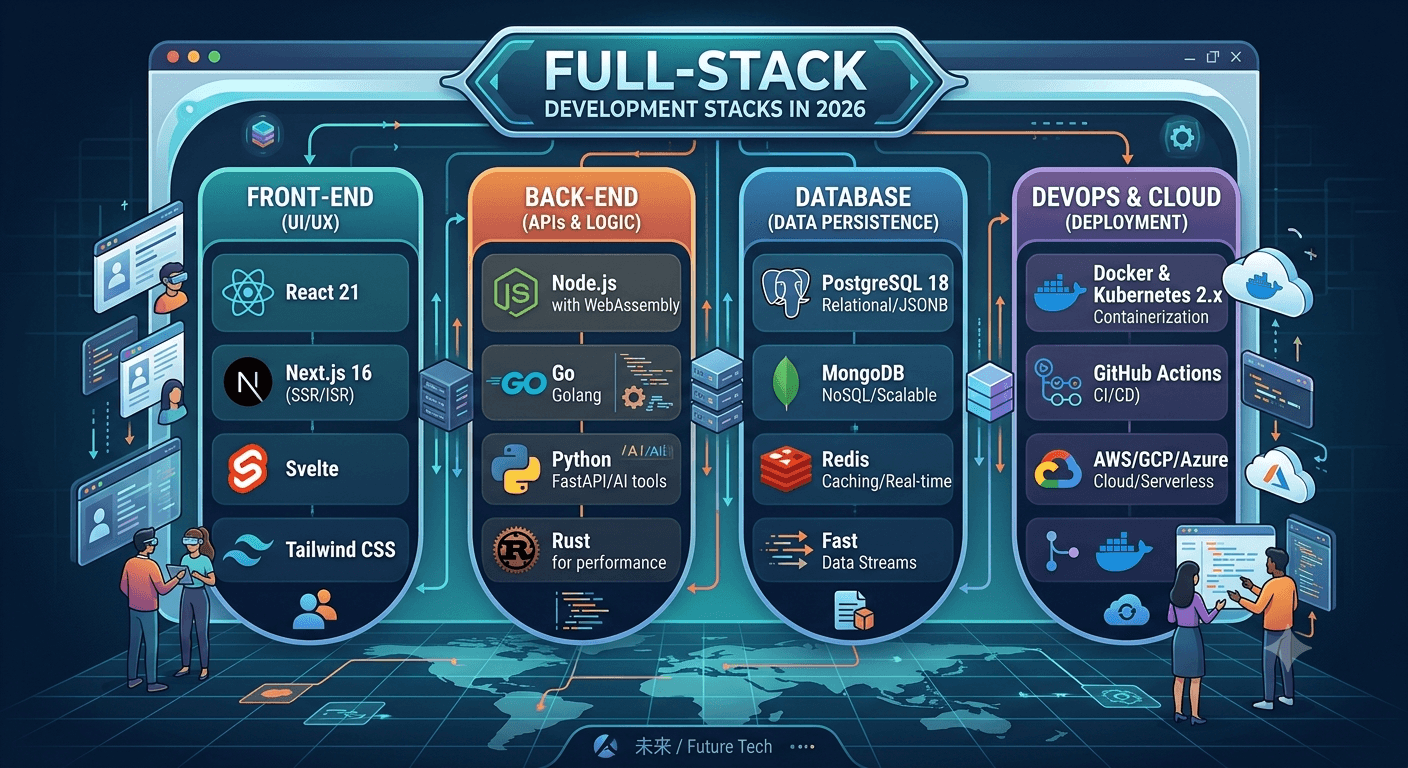
Front-End Technologies
React.js
React.js continues to be the most popular JavaScript library for building modern user interfaces. Its component-based architecture, Virtual DOM, and massive ecosystem make it the preferred choice for startups, enterprises, and SaaS platforms. React works seamlessly with Next.js, making it an excellent option for building SEO-friendly and high-performance websites.
Next.js
Next.js is one of the best React frameworks for production-ready applications. It provides Server-Side Rendering (SSR), Static Site Generation (SSG), Incremental Static Regeneration (ISR), API routes, and built-in image optimization. These features significantly improve SEO, website speed, and user experience.
Back-End Technologies
Node.js
Node.js remains one of the strongest backend technologies because it allows developers to use JavaScript across the entire application. Its event-driven architecture makes it ideal for APIs, real-time applications, chat systems, and scalable web platforms.
Deno
Deno is a modern JavaScript runtime created by the original developer of Node.js. It offers built-in TypeScript support, enhanced security, and simplified dependency management, making it an excellent choice for modern backend development.
Django
Django is a powerful Python framework known for its security, scalability, and rapid development capabilities. It includes built-in authentication, an ORM, and an admin panel, making it ideal for enterprise applications, SaaS platforms, and content-driven websites.
FastAPI
FastAPI has become one of the fastest-growing Python frameworks because of its outstanding performance, asynchronous capabilities, and automatic API documentation. It is widely used for AI-powered applications, machine learning services, microservices, and high-performance REST APIs.
Spring Boot
Spring Boot is a reliable Java framework designed for enterprise software development. It simplifies application configuration while delivering excellent scalability, security, and seamless integration with enterprise systems.
Go (Golang)
Go is widely adopted for cloud-native applications because of its simplicity, built-in concurrency support, and exceptional performance. Many companies rely on Go to develop scalable APIs, microservices, distributed systems, and cloud infrastructure.
Database Technologies
PostgreSQL
PostgreSQL is one of the most reliable relational databases available today. It supports advanced indexing, JSON data types, ACID compliance, and exceptional scalability, making it a preferred choice for modern web applications.
MongoDB
MongoDB is a leading NoSQL database that stores information using flexible document structures. It is an excellent solution for applications with rapidly changing data models, large datasets, and scalable architectures.
Redis
Redis is an in-memory database commonly used for caching, session storage, and real-time applications. It dramatically improves application performance by reducing database response times and supporting high-speed data processing.
DevOps and Deployment Technologies
Docker
Docker packages applications into lightweight, portable containers, ensuring consistency across development, testing, staging, and production environments while simplifying deployments.
Kubernetes
Kubernetes automates container deployment, scaling, orchestration, and management, making it the industry standard for deploying cloud-native applications at scale.
CI/CD Pipelines
Continuous Integration and Continuous Deployment (CI/CD) automate software testing, deployment, and monitoring. This enables development teams to release new features more quickly while maintaining high software quality.
Cloud Computing
Cloud platforms such as Amazon Web Services (AWS), Microsoft Azure, and Google Cloud Platform (GCP) provide scalable infrastructure, managed databases, serverless computing, AI services, and global content delivery for modern applications.
Frequently Asked Questions
What is the best full-stack technology in 2026?
One of the most popular full-stack combinations in 2026 includes React, Next.js, Node.js, PostgreSQL, Docker, and Kubernetes. This technology stack delivers outstanding performance, scalability, developer productivity, and long-term maintainability for modern web applications.
Is React better than Vue?
React offers a larger ecosystem, greater flexibility, and stronger enterprise adoption, while Vue provides a simpler learning curve and faster onboarding. The right choice depends on your project requirements, team expertise, and long-term development goals.
Is Next.js good for SEO?
Yes. Next.js is considered one of the best frameworks for SEO because it supports Server-Side Rendering (SSR), Static Site Generation (SSG), metadata optimization, image optimization, and excellent Core Web Vitals performance.
Which database should I choose?
Choose PostgreSQL for structured relational data, MongoDB for flexible document-based applications, and Redis for caching, session management, and real-time performance optimization. Many modern applications use all three databases together to achieve maximum performance and scalability.
Final Thoughts
Selecting the right full-stack development technologies in 2026 depends on your application's goals, scalability requirements, security needs, and long-term maintenance strategy. A modern stack built with React, Next.js, Node.js, PostgreSQL, Docker, and Kubernetes provides a powerful foundation for creating secure, scalable, SEO-friendly, and high-performance web applications. As web development continues to evolve, staying up to date with the latest frameworks, cloud technologies, and DevOps practices will help developers build future-ready applications that deliver exceptional user experiences.