The number on the invoice is not the number you pay
Training a model costs less than almost everyone assumes, and running it in production costs more. That gap is the entire story. The cost of building production AI rarely breaks a budget during the exciting part — the demo, the proof of concept, the pitch deck. It breaks the budget six months later, in the infrastructure bill, the on-call rotation, and the retraining nobody scheduled.
Here's the uncomfortable part: the training run is often the cheapest line item on the whole project. Fine-tuning a 13B parameter open-weight model on a few thousand examples can run $300 to $2,000 in GPU time on a service like Lambda or RunPod. Pretraining from scratch is a different universe — GPT-3 scale runs have been estimated in the millions — but almost nobody building a product does that. They fine-tune, or they call an API. Either way, the model itself is rarely where the money goes.
Where the Cost of Building Production AI actually hides
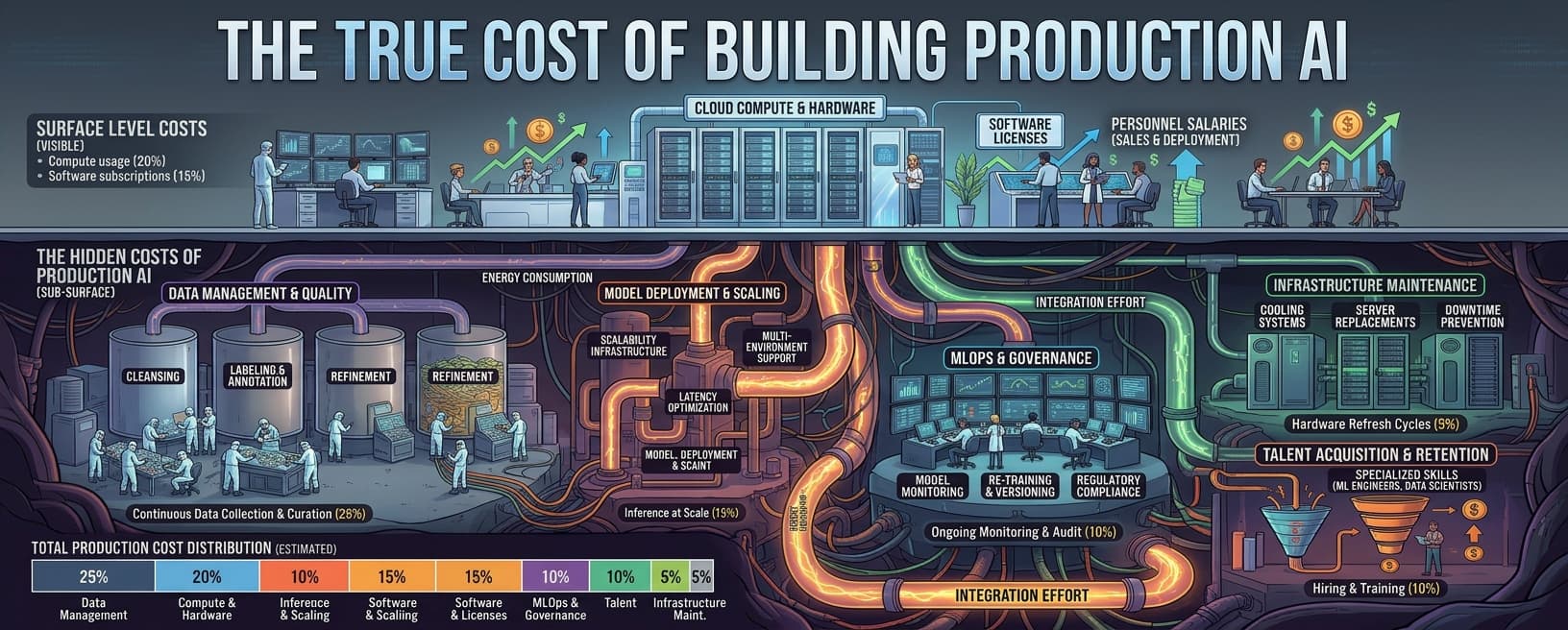
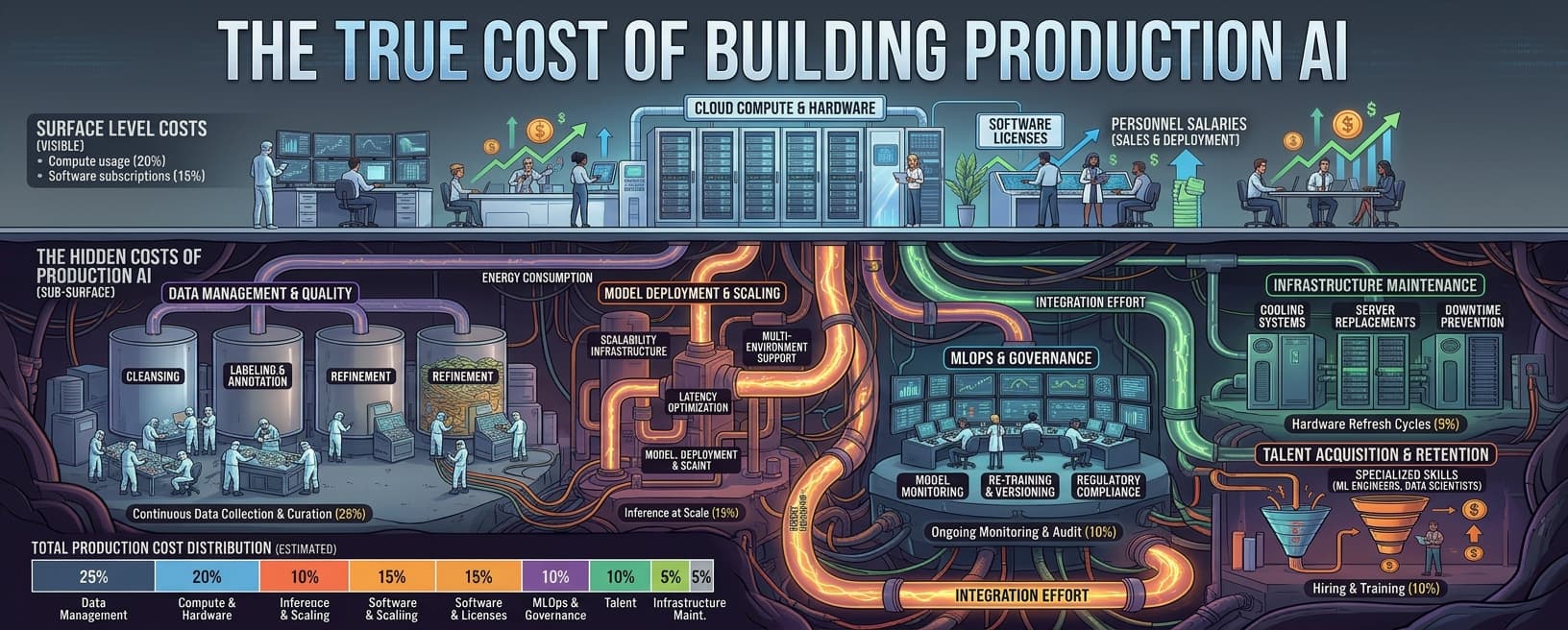
Break a real project into its pieces and the pattern is consistent. Model development — data collection, labeling, training or fine-tuning, evaluation — is maybe 20 to 30% of year-one spend for a team shipping something non-trivial. The rest goes to everything that keeps the model alive once it's answering real requests from real users at 2am.
Cost category | Typical share of year-one spend | What drives it |
|---|
Model training or fine-tuning | 15–25% | Data quality, compute hours, iteration count |
Inference infrastructure | 25–35% | GPU or API cost per request, concurrency, latency targets |
MLOps and monitoring | 15–20% | Logging, drift detection, retraining pipelines |
Engineering and integration | 20–30% | Serving layer, fallback logic, application code |
Compliance and security review | 5–10% | Data handling, audit requirements, sector rules |
Those percentages shift hard depending on scale. A startup serving 10,000 requests a day on a hosted API might spend almost nothing on infrastructure and everything on engineering time. A company running its own 70B model for 2 million daily requests flips that entirely — GPU cost dwarfs everything else, and a single misconfigured autoscaling policy can turn a $4,000 month into a $40,000 one.
The part that eats budgets quietly
Inference cost per request looks tiny in isolation — fractions of a cent on most hosted models. Multiply by volume and it stops looking tiny. A chatbot doing 500,000 conversations a month at an average of 1,200 tokens per exchange can land anywhere from $1,500 to $15,000 monthly depending on which model is serving it and how aggressively you cache repeated queries. Teams that skip caching entirely are often paying 2 to 3 times more than they need to.
MLOps isn't a nice-to-have, it's the thing that stops the bill doubling
Machine learning deployment expenses rarely come from one dramatic failure. They come from a hundred small inefficiencies — a model that should have been quantized and wasn't, a retraining job that runs nightly when weekly would do, a logging pipeline nobody built so an outage takes four hours to diagnose instead of twenty minutes.
MLOps implementation costs are real money upfront: tooling like MLflow or Weights & Biases, orchestration with something like Kubeflow or Airflow, and usually one engineer whose whole job is keeping the pipeline healthy. Budget $120,000 to $180,000 a year for that role in most US markets, less in distributed teams. It feels like overhead right up until the month a model silently degrades and nobody notices for three weeks because there was no monitoring dashboard to catch it.
The teams that get surprised by cost are almost never the ones who overspent on training — they're the ones who treated monitoring as optional.
Scaling is where the comfortable estimate falls apart
Scaling AI systems in production does not cost twice as much to serve twice as many users. It costs more than that, because latency requirements tighten, redundancy becomes non-negotiable, and you start paying for infrastructure you need 5% of the time just to survive the other 95%.
A system built to handle 50,000 users comfortably often needs a full redesign at 500,000 — new caching layers, load balancing across model replicas, sometimes a move from a single large model to a router that picks a smaller, cheaper model for easy queries and escalates the hard ones. That redesign is an engineering project in its own right, usually 8 to 16 weeks for a mid-sized team, and it's the part most cost estimates miss entirely because nobody plans past the initial launch.
Total cost of ownership AI calculations that stop at "compute plus salaries" miss the slow bleed: data storage for logs and training sets, the API costs for evaluation runs against held-out data, and the inevitable re-platforming when the vendor you picked at month three can't handle the volume at month fourteen. None of that shows up in a first-pass budget, and all of it shows up in the second-year one.
A worked example, because the abstractions don't help much
Take a mid-sized e-commerce company adding an AI product recommendation feature. Fine-tuning a small model on their catalog and purchase history: roughly $5,000 in compute and two weeks of a data scientist's time. Building the serving infrastructure, including A/B testing against the old rules-based system: another $25,000 to $40,000 in engineering time over six to eight weeks.
Then the ongoing cost: inference running at maybe $3,000 a month at their traffic level, an MLOps engineer splitting time across this and other projects (call it $40,000 a year allocated), and quarterly retraining as the catalog changes, another $2,000 to $4,000 each time. Year one total lands somewhere between $120,000 and $160,000, depending on how much rework the A/B test forces. That's a fair comparison point to any digital build — the same way a client comparing options would look at a Website Development Cost in Pakistan: Complete Pricing Guide before committing, except the AI version has a second, larger bill waiting twelve months out that a website rarely does.
Where teams actually cut this down
Caching repeated or near-duplicate queries, which can cut inference spend by 30 to 50% for anything with predictable traffic patterns.
Using a smaller model for easy cases and routing only hard queries to the expensive one, often halving average cost per request.
Fine-tuning an open-weight model instead of building a custom one from scratch, which can cut initial development cost by an order of magnitude.
None of those are secrets. They're just skipped under deadline pressure, which is precisely when the cost of building production AI quietly doubles.
An honest take: cheap launches are usually borrowed, not saved
The common advice says start small, ship fast, keep the stack simple. That's mostly right. But "cheap" at launch often just means the cost got deferred, not avoided — a system with no monitoring, no caching, and no retraining schedule looks inexpensive for exactly as long as nothing goes wrong.
Worth saying plainly: a machine learning deployment that costs $40,000 to launch and $8,000 a month to run isn't cheaper than one that costs $70,000 to launch and $2,500 a month to run. It just feels that way in the first quarter, which is usually when the budget gets approved and nobody's checking the twelve-month number.
Frequently asked questions
Can I estimate the cost of building production AI before I start?
You can get within a reasonable range if you separate training cost from infrastructure and operations cost, since the second two are usually 3 to 5 times the first over a year. Most teams underestimate because they only budget the training run and the initial API bill.
Is fine-tuning cheaper than training from scratch?
Almost always, and often by a factor of 50 to 100 in compute cost. Fine-tuning a 7B to 13B parameter open model typically runs from a few hundred to a few thousand dollars in GPU time, against hundreds of thousands or more for pretraining.
What's the single most underestimated ongoing cost?
Monitoring and retraining. Models drift as real-world data shifts away from training data, and catching that requires logging, evaluation pipelines, and someone checking dashboards weekly, not quarterly.
Does using a hosted API avoid most of the cost?
It avoids the training and GPU infrastructure cost, but not the engineering cost. You still need logging, rate limit handling, fallback logic, and evaluation, which is usually the majority of the build in an API-based project.
How does team size change the total cost?
A two-person team can ship a narrow production AI feature for the cost of a few months of salary plus API usage. A full platform with multiple models, retraining pipelines, and uptime guarantees usually needs a dedicated MLOps hire, which adds $120,000 to $180,000 a year in most US markets.