Website Development Cost in Pakistan: Complete Pricing Guide

Muhammad Mohsin
March 28, 2026•5 min read
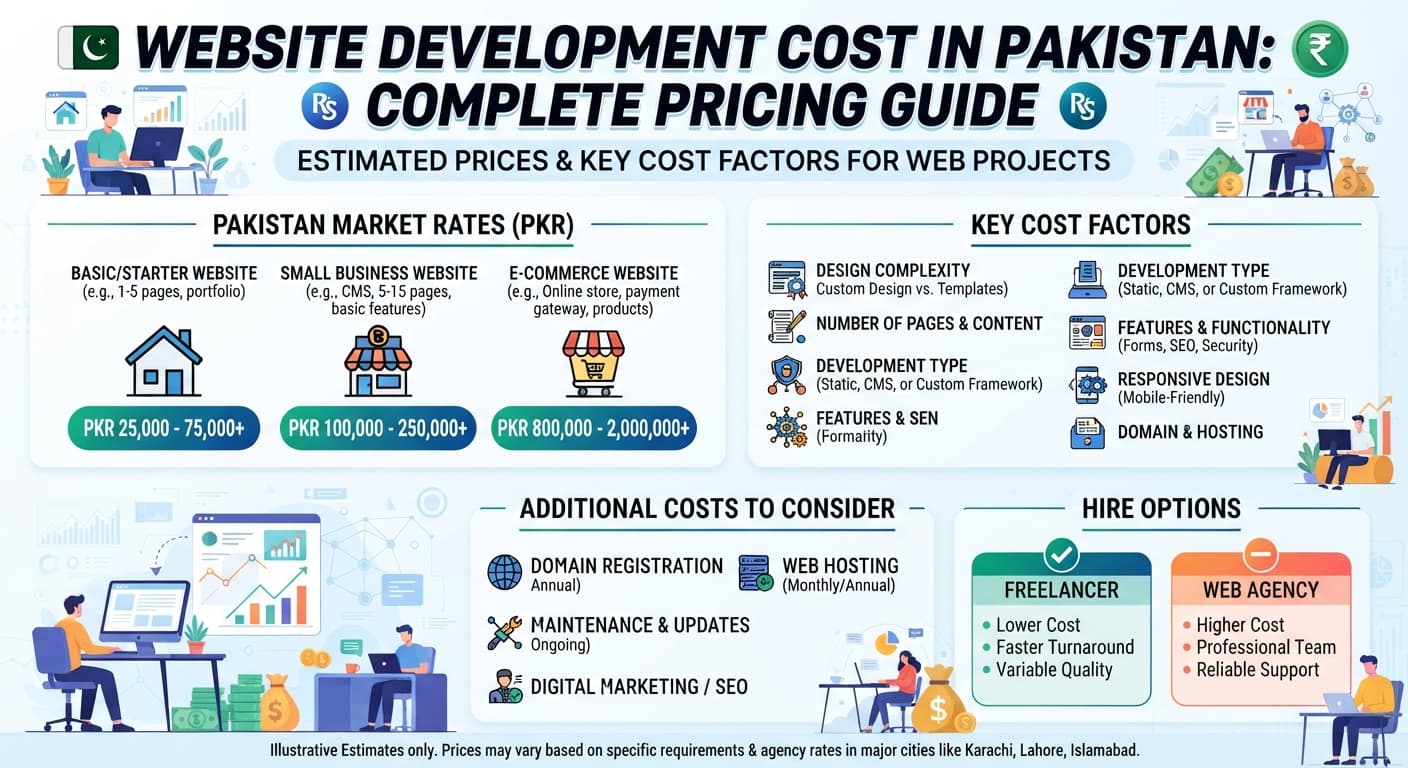
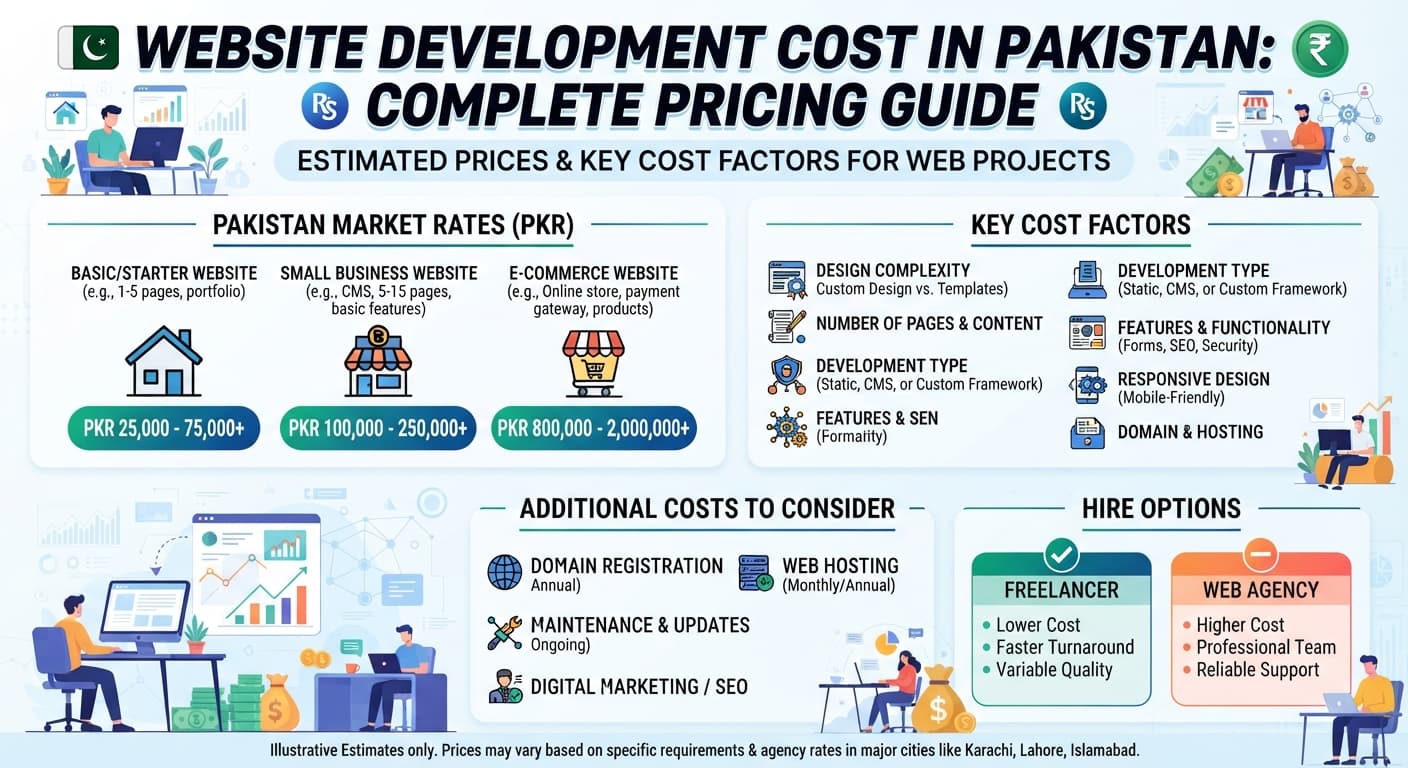
Website development in Pakistan costs PKR 10,000 to PKR 2,000,000+, depending on the type of site and how much of it is built rather than assembled.
Landing page: PKR 10,000 – 25,000
Basic business website (3–5 pages): PKR 20,000 – 60,000
Professional website (5–15 pages): PKR 50,000 – 200,000
E-commerce store: PKR 45,000 – 200,000
Custom web application: PKR 200,000 – 800,000+
For most small and medium businesses, a realistic budget for a professional website is PKR 60,000 – 200,000, plus PKR 20,000 – 60,000 for first-year running costs. That band is where the majority of Pakistani agency pricing clusters.
Those ranges are on every article about this. What isn't: what each price buys you over three years, who ends up owning your domain and code, and how to check whether a vendor's claims are true before you pay them.
We build websites in Pakistan, so read this as interested advice. It includes the parts that cost us work.
These are planning estimates, not quotes. Every figure was cross-checked against current published pricing from more than twenty Pakistani agencies, freelancers and marketplaces, then reconciled with our own quotations.
Where sources disagreed, we took the overlapping range rather than the widest one, which is why some figures here are narrower than the headline numbers you'll see elsewhere.
There is no official rate card for web development in Pakistan. No association publishes one and no regulator sets one. Anyone presenting a single number is describing their own pricing rather than the market's.
Last reviewed: Pricing checked against Pakistani agency and freelancer rates, marketplace listings, and current hosting and domain costs.
Website type | Cost (PKR) | Timeline |
Landing page / single page | 10,000 – 25,000 | 2–5 days |
Basic business site (3–5 pages) | 20,000 – 60,000 | 1–2 weeks |
Professional site (5–15 pages) | 50,000 – 200,000 | 3–6 weeks |
Basic e-commerce (up to 50 products) | 45,000 – 120,000 | 3–6 weeks |
Standard e-commerce (custom design, admin panel) | 100,000 – 200,000 | 6–10 weeks |
Custom web application | 200,000 – 800,000 | 12–24 weeks |
Enterprise platform | 800,000 – 2,000,000+ | 20–50 weeks |
Ongoing: hosting PKR 5,000–30,000/year, domain PKR 1,800–5,000/year, maintenance PKR 5,000–25,000/month.
Market ranges are useful for orientation. Real projects are more useful, so here's what we've actually built and what those builds cost. We don't publish exact figures against named clients, but these are the bands our work falls into.
Project type | What was included | Cost (PKR) |
Static business website | 5–7 pages, responsive, lead capture form, on-page SEO | 25,000 – 40,000 |
Professional business website | 20+ pages, custom design, CMS, advanced on-page SEO | 60,000 – 100,000 |
E-commerce store with admin panel | Product and inventory management, order tracking, customer database, P&L reporting, JazzCash and card payments | 80,000 – 200,000 |
Custom web application | User accounts and roles, dashboards, custom workflows, AI processing, integrations | 250,000 – 400,000 |
Enterprise platform | Multi-user system, custom workflows, integrations | 1,500,000 – 2,500,000 |
What the terms mean, since the difference is where most budget confusion comes from:
A website is read. Pages, content, a contact form. Visitors don't log in.
A web application is used. People log in, have accounts and permissions, and do work inside it — dashboards, records, workflows. This is where the price jumps, because you're building software rather than pages.
A SaaS platform is a web application serving multiple separate organisations at once, each seeing only their own data. Multi-tenancy, billing, onboarding, and per-organisation administration all sit on top of the application, which is why it costs more again.
Two things worth pointing out.
The e-commerce band includes the admin panel. Product and inventory management, order tracking, a customer database, profit and loss reporting, and payment integration. Several Pakistani agencies price a custom admin panel as a separate tier starting at PKR 250,000. We build it into the standard e-commerce scope.
The static website band sits at the bottom of the market range, and for the businesses that buy it, that's the right build — a credible presence and a lead funnel, not a platform. We'd rather quote that honestly than talk someone into a custom build they don't need.
The spread from PKR 25,000 to PKR 2,500,000 isn't inconsistency. Those are genuinely different products, priced for what each business needed.
There is no city-wide rate card anywhere in Pakistan. What varies is the mix of who's available and who's buying.
City | Business site | E-commerce |
Islamabad / Rawalpindi | 80,000 – 200,000 | 300,000 – 700,000 |
Karachi | 70,000 – 180,000 | 280,000 – 650,000 |
Lahore | 60,000 – 160,000 | 250,000 – 550,000 |
Faisalabad / Multan / Peshawar | 50,000 – 130,000 | 220,000 – 450,000 |
What actually drives the difference:
Client segment. Islamabad has government departments, NGOs, embassies, and development-sector organisations. Those buyers have procurement processes, compliance requirements, and larger budgets, and agencies price for that. Faisalabad's client base is mostly SMEs and manufacturers, so the same agency would quote differently there.
Agency versus freelancer concentration. Karachi and Lahore have the deepest talent pools and the most established agencies. Smaller cities skew heavily toward freelancers, which lowers the median price and widens the quality range considerably.
Operating costs. Office rent, salaries, and overheads differ, and they show up in quotes.
International work. Karachi and Lahore agencies do the most export work. An agency billing overseas clients in dollars has less reason to compete on price locally.
Project complexity. Bigger cities get more complex briefs, so their published ranges start higher — the same agency will still quote a simple site at a simple price.
The caveat that matters: remote work has compressed these gaps substantially. Today a Lahore agency serving an Islamabad client is completely normal, and the individual you hire matters far more than the city they sit in. Use these ranges to sanity-check a quote, not to decide where to look.
Two quotes for "a website" can differ by 10x because they're for different amounts of work. These are the variables that move the number, in rough order of how much they move it.
Design approach. A purchased theme with your branding dropped in is assembly. A design built from wireframes for your business is design work.
Concretely: a premium theme costs PKR 20,000–50,000, while a fully custom design converted from Figma runs PKR 80,000–150,000. Across the Pakistani agencies we reviewed, custom UI/UX consistently adds 30–50% to a project's total rather than a fixed amount.
Page count and content depth. Five pages is a base price. Twenty pages plus a blog adds PKR 50,000–150,000 — not because pages are hard, but because each one needs layout, copy and images.
Integrations. The biggest driver on most projects. A brochure site is straightforward. A site that talks to your payment gateway, inventory system, CRM, and courier API is four projects wearing one name.
Costs vary sharply by integration. A local payment gateway — JazzCash, EasyPaisa or XPay — typically runs PKR 15,000–35,000, because the integration is well-documented and every Pakistani developer has done it before. A CRM or ERP connection, or anything with a custom API, is PKR 50,000–150,000. If a vendor quotes JazzCash integration at PKR 100,000, ask what makes it complicated.
Two integrations Pakistani businesses ask for constantly, and which change a quote more than people expect: courier integration (pushing orders to PostEx, TCS, Trax or Leopards and pulling tracking back) and WhatsApp — either a simple chat button, which costs next to nothing, or the WhatsApp Business API for order confirmations and automated replies, which is real development work plus a per-message usage bill from Meta. Mention both before you're quoted, not after.
User accounts and dashboards. The moment your site needs logins, roles, and permissions, it stops being a website and becomes an application. Expect PKR 200,000+ on top.
Custom admin panels. "I want to manage it myself" can mean a standard CMS or a bespoke system for inventory, orders and reporting. The second one is where a lot of e-commerce budgets actually go.
Technology stack. WordPress with a page builder is the fastest and cheapest route. React, Next.js, Laravel or Node adds PKR 200,000–800,000, and is worth it only when you need what it gives you.
Performance work. Core Web Vitals, image optimisation, CDN setup: PKR 30,000–80,000. Skipped in most cheap quotes. It won't rank a site on its own, but a slow site competing against fast ones is starting behind.
Real SEO setup. Not "SEO-friendly." Proper titles and descriptions per page, schema, sitemap, Search Console: PKR 30,000–80,000.
Timeline. Rush jobs carry a 20–50% premium, because someone is rearranging other work to fit yours.
Revision rounds. Cheap quotes usually include one or two rounds of design changes. Projects with no single decision-maker — where three partners each give feedback — routinely run to five or six, and every extra round is billed or quietly absorbed by cutting corners elsewhere. Decide who approves before the project starts.
A bilingual site. English and Urdu, or English and Arabic for Gulf-facing businesses, roughly doubles the content work, and right-to-left scripts need their own layout testing. Budget it as a real line item rather than "just add a language switcher."
Who's doing the work? A senior developer costs more per hour and often less per project, because there's less rework. An agency costs more than a freelancer and buys you continuity rather than automatically better code.
Most guides stop at the list above, because the second half costs the writer money. Here it is anyway.
Use a premium theme instead of a custom design. Saves PKR 50,000–150,000. For a straightforward business site the visitor cannot tell, and your conversion rate won't know the difference.
Launch with fewer pages and expand later. Six good pages beat eighteen thin ones, and you can add the rest once you know which ones people actually want. Saves PKR 50,000–150,000 upfront.
Choose WordPress over custom code. Unless you need what custom gives you, this saves PKR 200,000–800,000 and makes the site cheaper to hand to anyone else later.
Write your own copy and supply your own photos. Saves PKR 30,000–100,000. You know your business better than a hired writer does, and a decent phone camera beats stock photography for a local business.
Give a realistic deadline. Removing the rush removes the premium.
Have your content ready before kickoff. The most common reason website projects in Pakistan stall isn't the developer — it's the client waiting on text, photos and product details. A stalled project still occupies the agency's calendar, and that cost shows up somewhere, usually in the next quote.
Phase the integrations. Launch with a contact form; add the payment gateway when you have products to sell through it. Every integration you defer is money you keep until you need the feature.
Ask what you can do yourself. Loading products, writing product descriptions, gathering testimonials. Many agencies will happily quote for this work and will equally happily leave it out if you say you'll handle it.
Negotiate milestone payments rather than a discount. Staged payments protect you more than a 10% price cut does, and vendors resist them less.
WordPress powers roughly 40% of the web and is what most Pakistani businesses end up on. It's also where the price spread is widest, because "a WordPress site" covers three very different amounts of work.
WordPress build | Cost (PKR) | What it is |
Theme-based | 20,000 – 45,000 | Purchased theme, your logo and content dropped in |
Customised theme | 45,000 – 90,000 | Theme reworked — layout changes, custom sections, real design input |
Fully custom WordPress | 90,000 – 250,000 | Designed from scratch, custom post types, ACF, built for your content |
WooCommerce, up to 50 products | 45,000 – 120,000 | Theme-based store, cart, checkout, one payment gateway |
WooCommerce, custom design + admin | 100,000 – 200,000 | 200+ products, custom UI, filtering, inventory management |
Monthly maintenance | 8,000 – 25,000 | Updates, backups, security, fixes |
What's not in that price:
Premium theme: PKR 7,000 – 15,000 one-off
Premium plugins: PKR 5,000 – 25,000 a year, and they renew
Elementor Pro or similar: around PKR 12,000 a year
Hosting: PKR 5,000 – 30,000 a year
The trap in WordPress pricing is the plugin stack. A site assembled from fifteen premium plugins is cheap to build and expensive to own — you're paying annual licences forever, and every plugin is a thing that can break, slow the site down, or become a security hole. Ask how many premium plugins your build depends on and what they cost annually.
When WordPress is right: content-led business sites, blogs, standard e-commerce, anything where you'll want to edit pages yourself, and any budget under PKR 250,000.
Custom means the site or application is coded for you rather than assembled from a CMS and plugins. Typically React or Next.js on the front end, with Node.js, Laravel or Python behind it, and a proper database.
Custom build | Cost (PKR) | Timeline |
Custom marketing site (Next.js/React) | 120,000 – 300,000 | 4–8 weeks |
Custom e-commerce with admin panel | 100,000 – 250,000 | 8–14 weeks |
Web application (dashboards, user accounts) | 200,000 – 800,000 | 12–24 weeks |
Mid-market enterprise platform | 150,000 – 750,000 | 16–30 weeks |
SaaS platform / multi-tenant system | 600,000 – 2,000,000 | 20–40 weeks |
Sanity-check any custom quote against hourly rates. Effective hourly rates in Pakistan sit in three rough bands:
Who | Effective rate (PKR/hour) |
Freelancer | 500 – 1,500 |
Small agency | 1,500 – 3,500 |
Established software house | 3,000 – 8,000 |
Experienced specialists in React, Laravel or Node.js generally bill toward the top of their band, and full-stack developers higher still. Agencies billing international clients in dollars mostly sit at $25–49 an hour — that's where the majority of Pakistani firms listed on Clutch place themselves.
That gives you a way to test a number. A quote of PKR 400,000 from a software house implies roughly 50–130 developer hours. If the scope obviously needs more than that, the quote is either optimistic or someone junior is doing the building. If it obviously needs less, ask what the rest is for.
What drives custom pricing up:
User accounts and permissions — login, roles, dashboards. Usually the single biggest jump, typically adding PKR 150,000–500,000
Integrations — payment gateways, ERP, CRM, courier APIs, WhatsApp Business API. Each is a mini-project
Custom admin panels — inventory, orders, reporting. This is where a lot of e-commerce budgets actually go
Real-time features — chat, notifications, live tracking
Third-party AI — transcription, document processing, agents
When custom is right: your business logic is genuinely unusual, you need integrations WordPress handles badly, you're building a product rather than a website, or performance and scale matter enough to justify the cost.
When it isn't: you want a brochure site that looks bespoke. Custom code for a five-page marketing site is money spent on something a good WordPress build does equally well and costs a fraction to maintain.
WordPress | Custom | |
Build cost | Lower | 2–4× higher |
Time to launch | 2–6 weeks | 8–24 weeks |
Who can edit content | You, without help | Depends on what was built |
Ongoing licences | PKR 10,000 – 40,000/year | Usually none |
Maintenance | Plugin and core updates, monthly | Lower frequency, higher skill |
Finding another developer | Easy — large local talent pool | Harder, more expensive |
Performance ceiling | Good with work | Higher |
Scales to complex features | To a point | Yes |
The long-term point most guides miss: WordPress is cheaper to build and cheaper to hand over, because thousands of developers in Pakistan know it. Custom is more expensive to build and, if written well, cheaper to run — but if the original team disappears and the code is undocumented, you're in a worse position than you would have been with WordPress.
So the real question isn't which is cheaper. It's whether the thing you're building actually needs custom code — and for most businesses under PKR 250,000, it doesn't.
Shopify is the other platform most Pakistani store owners consider, and its pricing works completely differently.
Shopify | WooCommerce | |
Platform fee | Monthly, billed in USD (Basic around $39/month, roughly PKR 11,000) | None — the plugin is free |
Build cost | Lower — setup and theme work | Higher — but you own the result |
Local payments | JazzCash and Easypaisa need third-party apps; COD usually needs an app too, often PKR 2,000–5,000/month | Integrated directly, no monthly app fees |
Three-year platform fees | Roughly PKR 400,000 – 1,000,000 depending on plan and apps | Hosting and plugin licences only |
Exchange-rate exposure | Every bill rises when the rupee falls | Mostly paid in PKR |
Moving away later | Possible, but you rebuild the theme | You own the code and database |
The short version: Shopify is cheaper to start and more expensive to keep. It suits stores that want to launch in days, sell internationally, and would rather pay monthly than manage hosting. WooCommerce, or a custom store, usually wins for Pakistan-focused businesses selling mainly through local payment methods and cash on delivery — the monthly app fees for those are exactly the costs that compound.
E-commerce quotes cover building the store. These costs come from operating it, and none of them appear in a development quote.
Payment gateway fees. Card payments in Pakistan typically carry a merchant discount rate of 1.5–3.5% per transaction. Some gateways charge a setup fee of PKR 10,000–100,000; others waive it. Chargebacks — when a customer disputes a card payment — can cost PKR 2,000–8,000 each. Ask for the full fee schedule in writing, including settlement time, which should be one or two working days for domestic payments.
Cash on delivery. Most Pakistani online orders are still COD, which means courier COD charges, slower cash flow, and the cost of refused deliveries that come back. Traditional couriers can take 10–15 days or more to remit COD collections; some newer ones, such as PostEx, pay out much faster. That choice affects your working capital more than your website does.
WhatsApp Business API. If your store sends order confirmations or updates on WhatsApp through the official API, Meta charges per message in US dollars — currently about $0.015 per utility message and $0.047 per marketing message in Pakistan, with 1,000 free customer-service replies per number each month. Small per message, real at volume.
Operations. Stock updates, order processing, returns and customer messages are daily work. For many stores this ends up costing more over a year than the website did.
This is the calculation that changes which quote is actually cheaper, and it's missing from most guides ranking for this term.
Build | Year 1 running | Year 2 | Year 3 | Rebuild | 3-year total | |
Budget site | 30,000 | 12,000 | 12,000 | 12,000 | 150,000 | 216,000 |
Professional site | 180,000 | 15,000 | 60,000 | 60,000 | — | 315,000 |
Custom build | 350,000 | 25,000 | 90,000 | 90,000 | — | 555,000 |
The gap between the budget and professional options over three years is about PKR 99,000 — not the PKR 150,000 the opening quotes suggested. And the professional site was producing enquiries for two of those three years while the budget one wasn't.
Why the rebuild line only appears on the first row: budget sites tend to get replaced rather than improved. By year three the theme is unsupported, the plugin stack is outdated, performance is poor and the structure won't take what you now need. Fixing costs more than starting again. Not every cheap site follows this path, but enough do that you should budget for the possibility.
This is not an argument that expensive is better. Plenty of PKR 400,000 websites are bad, and plenty of PKR 60,000 ones do exactly what the business needed. It's an argument that comparing opening quotes tells you very little about what you'll actually spend.
Knowing what things cost doesn't tell you what you should spend. Six steps to get to a number.
1. Write down what the site has to achieve. In business terms, not features. "Twenty enquiries a month" or "sell 50 orders a week" or "look credible enough that clients stop asking whether we're a real company." A site with no defined job can't be budgeted for.
2. Work out what one customer is worth. This is the step almost nobody takes, and it reframes everything. If a client is worth PKR 200,000 to you, arguing over a PKR 40,000 difference in build cost is the wrong argument — one extra client pays for the gap five times over. If a customer is worth PKR 2,000, the maths runs the other way and you should be at the cheap end.
3. Split your feature list into launch and later. Write everything you want, then mark each item "needed on day one" or "needed eventually." Most people's must-have list is half wishlist, and the exercise usually removes 30–40% of the scope.
4. Pick the platform from that list, not from preference. If nothing on the day-one list needs custom code, use WordPress. Choosing a stack before knowing the requirements is how budgets get set by fashion.
5. Add 20% for year one running costs. Hosting, domain, plugins, content, the changes you'll want in month two.
6. Get three itemised quotes and compare scope, not price. One agency quoting PKR 80,000 with hosting, content and three months of support may be better value than another quoting PKR 55,000 for a template with nothing after handover. You can only see that if the quotes are itemised, so ask for that specifically.
If those six steps produce a number that doesn't match what you want built, the answer is to cut scope rather than to find a cheaper vendor. A reduced site built properly beats the full site built badly, and it's the version you won't have to rebuild.
Nobody writing about website costs in Pakistan covers this, and it causes more expensive problems than pricing does.
If your developer registers your domain "for you" on their own account, changing vendors becomes a negotiation. If they created your Google Analytics, you lose every year of historical data when you leave. If the site is built on a proprietary system, you can't take it anywhere at all.
Go through this before you sign, and again at handover.
☐ Domain registered in my name, in my registrar account
☐ Hosting account in my name, billed to my card
☐ cPanel / hosting control panel login
☐ WordPress admin login (Administrator role, not Editor)
☐ Full source code and project files
☐ Database access and a current export
☐ Google Analytics — property owned by my account
☐ Google Search Console — verified on my account
☐ Google Business Profile — owner, not manager
☐ Premium theme licence, in my name
☐ Plugin licences and renewal dates, in writing
☐ Backup access, and where backups are stored
☐ Written confirmation I own the code after final payment
Anything unticked is something you'd have to negotiate for later, usually at the worst possible moment. A vendor who resists any line on this list is telling you something useful.
"Ask to see their portfolio" is standard advice and nearly useless, because screenshots prove nothing. Here's what actually verifies quality, and all of it takes about fifteen minutes.
Test their own website first. Put their domain into PageSpeed Insights. If a web development company's own site scores badly on mobile, that answers most of your questions.
Ask for three live URLs, not images. Then open each one on your phone. Does it load in under three seconds? Does the navigation work? Is the copyright year current, or stuck in 2021? Sites frozen years ago suggest clients who left.
Search for their client on Google. If they say they built a business's site, search that business's name. Does the site come up? If a company selling you SEO-ready websites has built sites that don't appear for their own brand name, that's your answer.
Ask who is writing the code. Specifically: is the person in this meeting the person building it? In many agencies they aren't, and the handoff between salesperson and developer is where scope gets lost.
Ask what happens in week three after launch. When something breaks — and something breaks — who fixes it, how fast, and is it billable?
Ask to see a site they built two years ago. Then ask what it has cost the client to run since. Launch-day screenshots tell you about design; a two-year-old site that's still fast, still updated and still owned by the client tells you about the vendor.
Almost every quote in Pakistan includes "SEO-friendly" or "SEO-ready." It usually means the developer installed Yoast and left the default settings.
Here's what the phrase should cover. Print it, and ask which items are included.
Crawling and indexing
☐ Pages render crawlable HTML
☐ XML sitemap containing the pages actually published
☐ robots.txt not blocking anything important
☐ Canonical tags, self-referencing by default
☐ No accidental noindex on live pages
☐ Clean, readable URLs
On-page
☐ Unique title and meta description per page, written for that page
☐ One H1 per page, sensible heading hierarchy
☐ Image alt text
☐ Internal linking between related pages
Technical
☐ Mobile usable, tested on a real phone
☐ Core Web Vitals passing
☐ Images compressed and served in modern formats
☐ HTTPS across the whole site
☐ 404 page that works
☐ Redirects mapped if replacing an existing site
Structured data and setup
☐ Schema where it applies (Organization, LocalBusiness, Product, Article)
☐ Google Search Console verified on your account
☐ Sitemap submitted
☐ Google Analytics installed on your account
We audit sites where more than half the live pages were missing from the sitemap entirely, which means Google never sees them. The work was done; nobody checked.
If the answer to "which of these are included" is vague, budget PKR 30,000–80,000 separately for someone to do it properly, or accept that the site will exist without being findable.
Cost | Typical (PKR) | When it hits |
Hosting renewal | 5,000 – 30,000/year | Year two, often above the introductory price |
Domain renewal | 2,500 – 6,000/year (.pk and .com.pk around 3,900) | Annually |
Content writing | 3,000 – 10,000/page | Once you realise you have to supply it |
Photography | 20,000 – 80,000 | Same moment |
Premium plugins/themes | 5,000 – 25,000 | During build |
SSL | 0 – 10,000/year | Free with most good hosts |
Maintenance | 5,000 – 25,000/month | Ongoing, or you skip it and pay later |
Post-launch changes | Hourly or per-change | Continuously |
USD-billed subscriptions | Varies with the dollar | Every renewal — premium plugins, page builders, Shopify, some hosting |
Provincial sales tax | Depends on province | On the invoice, if the vendor is registered |
Add PKR 20,000–60,000 to any quote for first-year running costs. Most people don't and are surprised. A useful rule for later years: budget 15–25% of the build cost each year for upkeep. A quote that doesn't account for that isn't cheaper, it's just moving the cost to later.
Hosting type | Typical cost (PKR) | Good for |
Shared hosting | 4,000 – 15,000/year | Brochure sites, small WordPress sites |
Managed WordPress | 5,000 – 25,000/year | WordPress sites where you want updates and backups handled |
Managed cloud (Next.js, serverless) | 12,000 – 40,000/year | Custom-built sites and modern frameworks |
VPS | 60,000 – 180,000/year | Busy stores, web applications |
Dedicated server | 150,000+/year | High-traffic platforms |
Check the renewal price, not the first-year price. Many hosts advertise a low introductory rate that rises at renewal. A host that's cheap in year one and expensive from year two isn't cheap.
Provincial sales tax on IT services. Services in Pakistan are taxed by province, and IT services generally carry a reduced rate — Punjab, for example, charges 5% on IT services against a standard 16%, and Sindh offers reduced rates for IT services too. Ask whether a quote is inclusive or exclusive of tax, so two quotes are compared on the same basis. Tax rules change; check the current rate with your accountant.
Maintenance is the one people skip. It feels like saving money for roughly a year. Sites without it don't stay still — plugins break, security lapses, speed degrades — and the eventual fix costs more than the maintenance would have.
Cost | Works when | Fails when | |
Website builder | 2,500 – 5,000/month | Simple site, you'll maintain it, need it this week | You need custom features, want to own the platform, or don't want bills that rise with the dollar |
Freelancer | 20,000 – 80,000 | Clear simple scope, you can manage the project | They vanish, get busy, or you need support in month six |
Agency | 60,000 – 500,000+ | Business-critical site, integrations, you want accountability | Budget is genuinely small — you'll get their junior work |
The honest framing: a good freelancer beats a bad agency easily. The agency premium buys accountability and continuity, not automatically better code. Judge the individual, not the category.
Quotes before questions. A vendor who gives a price before asking what the site must achieve is quoting a package, not your project.
Prices with no scope attached. "PKR 50,000 for a website" is meaningless without a page count, feature list, and what's excluded.
100% payment upfront. The standard term across Pakistani agencies is 60% upfront and 40% on completion, sometimes split further into milestones on larger projects. Full payment upfront is a real risk — you lose all leverage the moment you pay. So is no deposit at all, which usually means they don't value their own time.
No written scope. If what you're buying only exists in WhatsApp messages, expect disagreement about it later.
Unlimited revisions. Sounds generous. It means the project has no defined end, and projects without an end don't get finished.
Nobody says no to anything. A vendor who agrees to every feature request in the first meeting either hasn't thought about it or is planning to charge for it later.
No — and this is where most agency-written guides get self-serving.
A PKR 20,000–30,000 website can be entirely reasonable. What matters is whether the price matches what's being promised.
A cheap quote is fine when it includes:
A purchased or free theme, lightly customised
Five pages or fewer
Content and images supplied by you
No custom functionality
One or two rounds of revisions
Handover, with support billed separately
That's a real product, honestly priced, and for a tradesman or a small local business it may be exactly right.
A cheap quote is a warning sign when it promises:
Custom UI/UX design
Professional copywriting included
Technical SEO included
E-commerce with payment gateways
Custom integrations
Speed and Core Web Vitals optimisation
Unlimited revisions
Ongoing support at no extra cost
Nobody can deliver that list for PKR 20,000. Either the work won't happen, or it'll be done badly, or the price will rise once you've committed. The problem isn't the number — it's the mismatch between the number and the promise.
Under PKR 50,000? Don't hire a custom developer. Use WordPress with a well-supported theme, or Shopify if you're selling products, and put the difference into photography and copy — both affect conversion more than custom design does at that budget.
Not sure the site will drive business? Build something small, run it six months, see whether anyone arrives. Then invest properly.
Need customers this month? A website is a 3–12 month play. Google Ads works next week.
Selling entirely through referral or Instagram? Check whether anyone searches for what you sell before committing to a year of retainers.
How much does a basic website cost in Pakistan? A basic 3–5 page business website costs PKR 25,000–80,000. The spread depends on whether the design is template-based or custom, and whether content is included.
How much does a WordPress website cost in Pakistan? PKR 30,000–60,000 for a template build, PKR 80,000–250,000 for a custom design. WordPress itself is free; you pay for hosting, the domain, premium plugins, and the work.
How much does an e-commerce website cost? A basic WooCommerce store with up to 50 products, one payment gateway and a purchased theme starts around PKR 45,000–60,000. A custom-designed store with 200+ products, filtering, inventory management and an admin panel runs PKR 100,000–200,000.
Some agencies price a custom admin panel as a separate tier at PKR 250,000–600,000. It doesn't have to be — we build inventory, orders and reporting into the standard e-commerce scope rather than charging for it separately.
Note that several Pakistani agencies serving international clients quote e-commerce in dollars — $3,000–8,000 for a template store, $10,000–25,000 for custom. Those are export rates, not local ones, and they're why you'll see wildly different numbers depending on which page you land on.
How long does it take? Basic site: 1–2 weeks. Custom business site: 3–6 weeks. E-commerce: 6–10 weeks. Custom application: 12–30 weeks. Anyone promising a custom site in a week is assembling a template.
Does the quote include hosting and domain? Sometimes for year one, rarely after. Ask explicitly, and ask what year-two renewal costs.
Can I move my website to another developer later? Only if you own the code, domain and hosting. Ask before signing — some agencies build on platforms you can't take with you.
Is WordPress or custom development better? WordPress for most content-led business sites. Custom when you need something WordPress doesn't do well — complex integrations, custom workflows, or an application rather than a website. A vendor who recommends the same thing to everyone isn't answering the question.
What are standard payment terms in Pakistan? Most Pakistani agencies work on 60% upfront and 40% on completion. On larger projects this is often broken into three or four milestones. Anything demanding 100% upfront is a risk; anything asking for nothing upfront usually means the vendor isn't busy.
How much does a Shopify store cost in Pakistan? Setup and theme work from a Pakistani developer is usually cheaper than a WooCommerce build, but the platform itself is billed monthly in dollars — around PKR 11,000 a month on the Basic plan — plus apps for local payments and COD. Over three years, platform fees alone often reach PKR 400,000 or more.
Do website quotes include sales tax? Not always. IT services are taxed provincially at reduced rates, and registered vendors add it to the invoice. Ask whether each quote is tax-inclusive before comparing them.
How much does a website redesign cost? Usually about the same as a new build of the same scope, plus migration work: moving content and mapping every old URL to its new one with redirects. Skip the redirect mapping and you can lose the search rankings the old site had built up — which is the most expensive mistake in a redesign.
Do I need a privacy policy? Pakistan's Personal Data Protection Bill is still a draft, but the Prevention of Electronic Crimes Act 2016 already penalises misusing people's identity information, and payment gateways and app stores will typically ask for privacy and refund policy pages. If you sell to customers in the UK or EU, their data-protection rules apply too. Budget for having these pages written properly.
Why do quotes vary by 10x? Mostly because they're for different products. Sometimes because one quotes senior people and the other juniors. Occasionally because someone is expensive. Comparing itemised scopes rather than headline numbers is the only way to tell.
Write down three things: what the website must achieve in business terms, who your competitors are, and what you'll supply yourself versus what you need done.
Then flag anything Pakistan-specific up front, because each of these changes the quote and none of them get assumed:
Cash on delivery
JazzCash, Easypaisa or card payments
Courier integration and order tracking
WhatsApp ordering or notifications
Urdu or Arabic as well as English
Moving content and rankings from an existing site
And ask every vendor for two lists, not one: what's included, and what isn't.
Vendors who quote before asking those questions are quoting a package.
We give fixed quotes in writing after a free scoping call, from our offices in Islamabad and Lahore — including the honest verdict when your budget and requirements don't match, and what to do about it.
→ Web development in Pakistan → Islamabad · Lahore · Karachi → Talk to us about your project
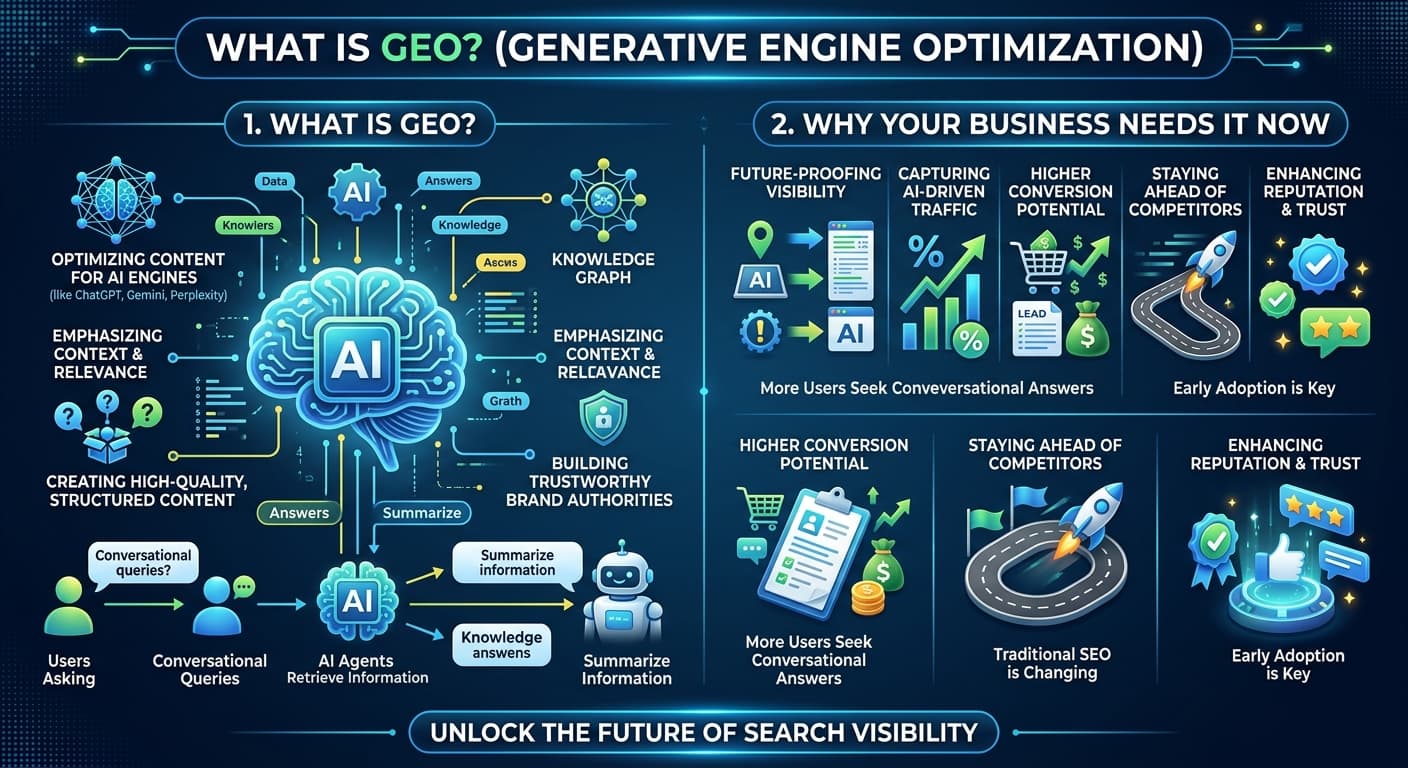
AI Overviews just cut organic click-through rates by more than half. This post explains what generative engine optimization actually is, what the ranking guides leave out, and where to spend your time first.

Launched on January 1, 1985, the .com domain is one of the most widely used and recognized domain extensions on the internet. A domain extension, also known as a top-level domain (TLD), is the last part of a web address, such as .com, .org, or .net. Originally intended for commercial businesses, the .com extension has evolved into a versatile choice for all types of websites, making it the default domain extension for many.