The price tag is no longer a fixed promise
Most shoppers assume a price tag is a firm agreement between a buyer and a seller. Historically, if you walked into a store on Monday and Friday, the price of a gallon of milk stayed the same. Digital commerce has fundamentally broken this expectation. The number you see on your screen is increasingly a temporary reflection of a massive data set, calculated in milliseconds. Understanding how this pricing work customer psychology can be the difference between a high-profit margin and a permanent loss of brand equity.
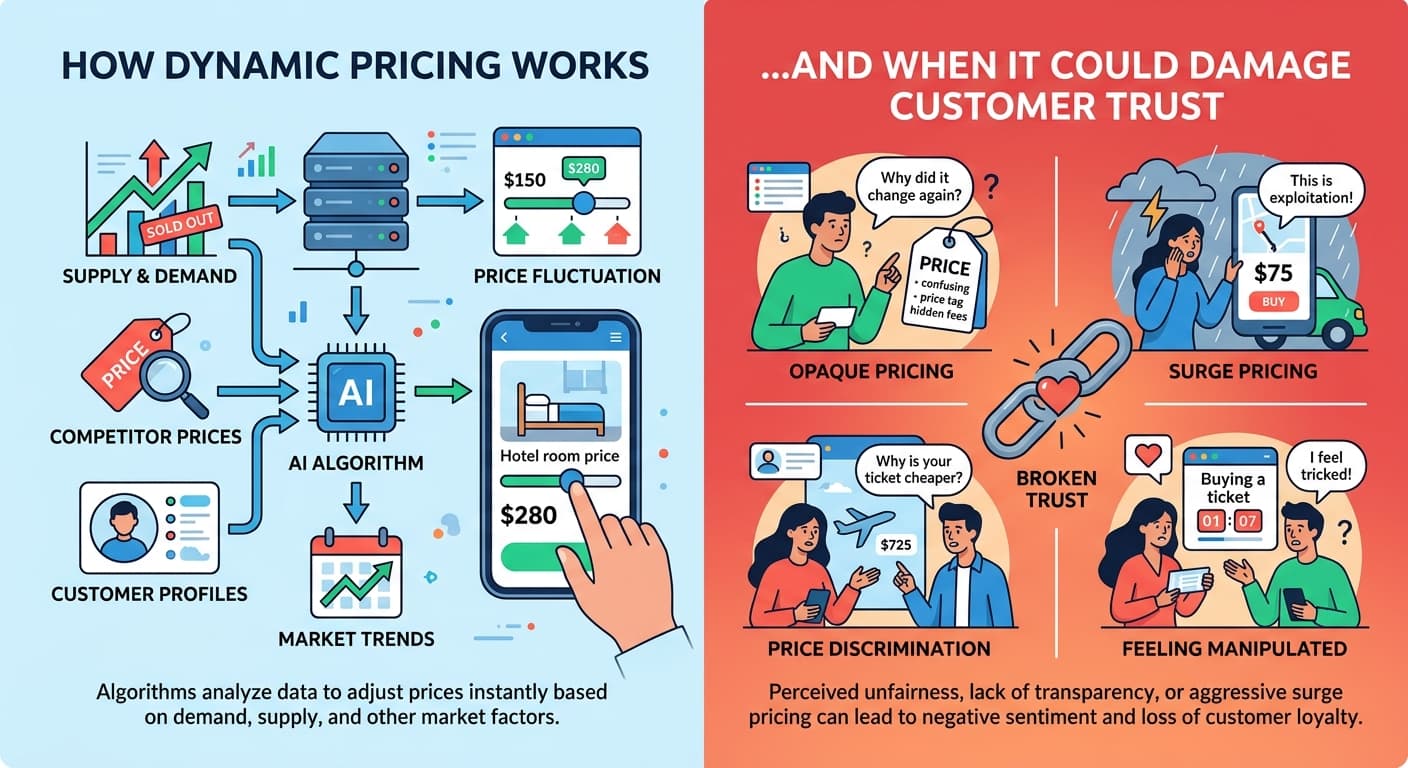
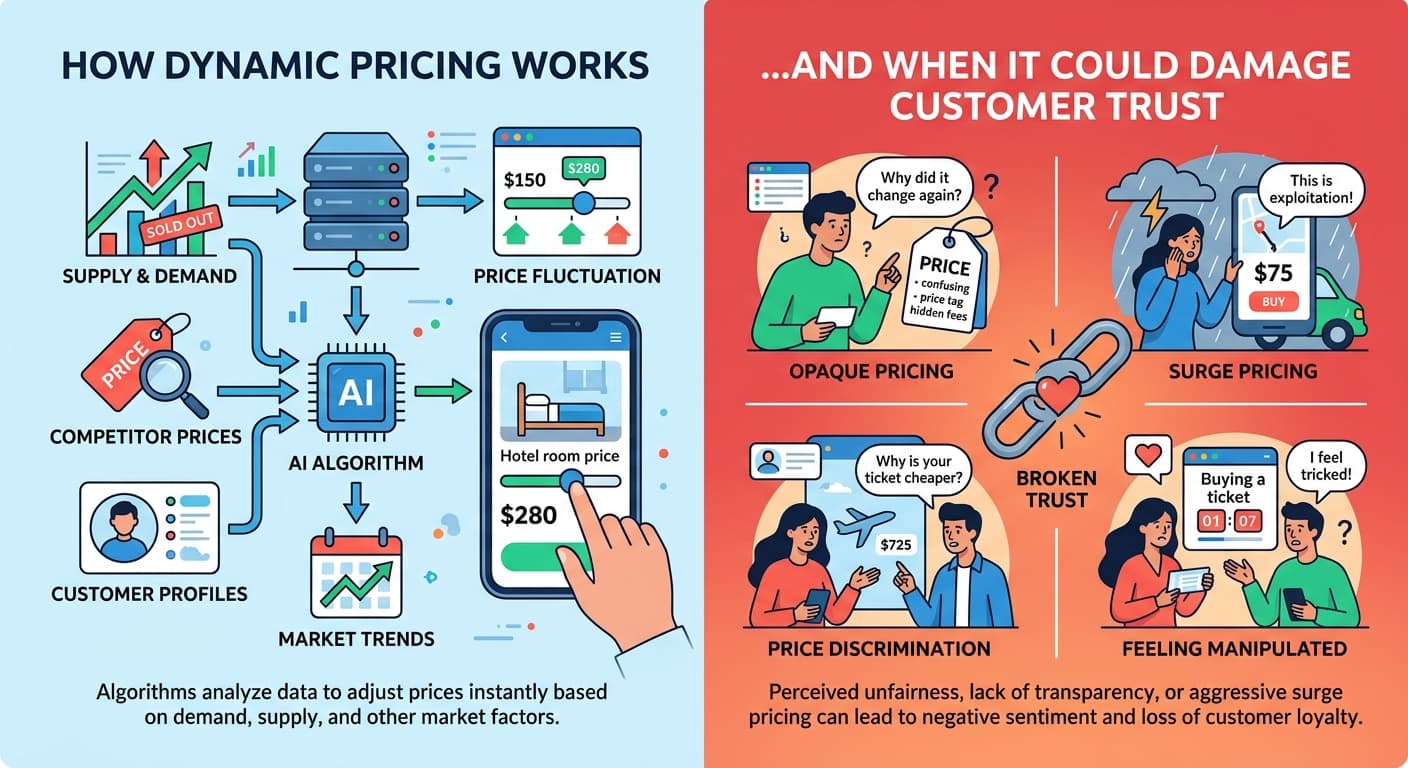
Dynamic pricing is the practice of adjusting prices on the fly based on market demands, competitor moves, and even individual user behavior. It is the reason an airline ticket costs $200 in the morning and $450 by dinner. It is the reason Uber charges more when it rains. While businesses love it for the efficiency, customers often view it with suspicion. If a customer feels they are being hunted for their data rather than served for their needs, the relationship sours instantly.
The goal here is to look at the mechanics of real-time price optimization and define the line where efficiency becomes exploitation. We will look at specific tools, the math behind the curtain, and the specific instances where a company should—and should not—toggle the switch on fluctuating costs. To understand the technology behind these shifts, it helps to look at Static vs. Dynamic Websites: Which One is Right for Your Business? because the infrastructure dictates what is possible.
The criteria for judging a pricing strategy
Before criticizing or praising any specific method, we have to agree on what a successful strategy looks like. A pricing model is not successful just because it generates a 5% revenue bump this quarter. It has to survive the "Sunday morning test"—would you be comfortable explaining the logic to a customer over coffee? Here is how we evaluate these systems:
Transparency: Does the customer know why the price changed, or does it feel like a secret tax?
Predictability: Can a regular user anticipate the shifts, or is it a random lottery?
Fairness: Is the price based on external factors (like supply) or internal factors (like the user's bank balance)?
Value Alignment: Does the price increase reflect a genuine increase in the difficulty or cost of providing the service?
When you see how this pricing work customer satisfaction often hinges on these four pillars. If even one is missing, the algorithm starts to look like an adversary rather than a tool. Many retailers ignore these criteria in favor of short-term gains, only to find that their customer acquisition costs skyrocket as trust evaporates.
How the math of real-time price optimization actually works
At the heart of every dynamic system is a set of price discrimination algorithms. These are not simple "if-then" statements; they are complex models that ingest thousands of data points. They look at historical sales data, local weather patterns, competitor inventory, and even the battery life of the device you are using to shop. For those curious about the underlying logic of these systems, our guide on Technoblick provides the foundational context for how machines make these split-second decisions.
In a retail environment, the system might see that a competitor has run out of stock on a specific blender. Within seconds, your site might raise the price of that same blender by $10. The algorithm knows that customers who need that blender today will likely pay the premium rather than wait for a restock elsewhere. This is the way pricing work customer interactions are handled at scale by giants like Amazon, which changes prices millions of times a day.
There are three main buckets these algorithms fall into:
Supply-Based: Prices rise when inventory is low and demand is high (e.g., hotel rooms during a convention).
Time-Based: Prices shift based on the time of day or day of the week (e.g., happy hour at a bar or cheaper movie tickets on a Tuesday).
Behavior-Based: This is the controversial one. It uses your browsing history, location, and purchase power to guess the maximum you are willing to pay.
The supply-based and time-based models are generally accepted because they mirror common sense. Behavior-based models, however, are where the pricing work customer trust begins to fracture. If I am charged more because I am browsing from a high-end zip code, I don't feel like I'm participating in a market; I feel like I'm being profiled.
Comparing dynamic pricing models
Model Type | Specific Example | Who It Suits | Who It Alienates |
|---|
Surge Pricing | Uber, Lyft | Users needing immediate, guaranteed service during peaks. | Budget-conscious commuters on a fixed income. |
Yield Management | Delta, Marriott | Last-minute business travelers with high budgets. | Families planning vacations who need price stability. |
Flash Sales | Steam (Gaming), Amazon | Bargain hunters who enjoy the "hunt" for a deal. | People who value their time over saving five dollars. |
Personalized Pricing | Orbitz (Historical), Insurance | Nobody, truly. It is a pure margin-play for the seller. | Literally every savvy consumer who discovers it. |
The way this pricing work customer loyalty depends entirely on which row of that table you occupy. If you are running a service like Uber, surge pricing is a necessity to keep drivers on the road. Without the higher fare, drivers stay home, and nobody gets a ride. Here, the price hike serves a functional purpose. However, if a grocery store raises the price of bottled water during a heatwave, there is no functional benefit to the consumer—it is pure opportunism.
Surge pricing customer perception: Why Uber gets away with it (mostly)
Uber is the poster child for surge pricing. While people complain about a 3x multiplier on New Year's Eve, the brand has mostly survived the backlash. Why? Because they are transparent about it. You see the price before you book. There is no "gotcha" at the end of the ride. The app even tells you that prices are higher due to increased demand, which aligns with the customer's observation of the world around them (it's raining, it's a holiday, etc.).
The problem arises when the logic is hidden. Imagine if Uber didn't tell you about the surge until the ride was over. The pricing work customer response would be explosive. This tells us that the damage isn't caused by the price itself, but by the lack of personalized pricing transparency. When a customer feels like the rules of the game are being changed in the middle of the match, they stop playing.
For smaller businesses, implementing this level of complexity requires significant investment. When calculating the Website Development Cost in Pakistan: Complete Pricing Guide, one must factor in the heavy lifting of API integrations and database management required to handle real-time price updates. It is not a "set it and forget it" feature; it requires constant monitoring to ensure the algorithm doesn't do something socially disastrous.
The "Creepy" factor in personalized pricing
There is a specific line between "smart business" and "creepy behavior." In 2012, Orbitz found that Mac users were willing to spend up to $30 more per night on hotels than PC users. They didn't necessarily charge more for the same room, but they showed Mac users higher-priced options first. While technically legal, this kind of consumer trust pricing fairness is fragile. If a user realizes they are being shown a filtered reality based on their hardware, they feel manipulated.
To make this pricing work customer sentiment must stay positive. If the algorithm starts using "vulnerability markers"—like realizing a customer is in a hurry or needs a specific medicine—and hikes the price, that is a brand-killing move. Real-time price optimization should be used to manage your inventory, not to exploit the customer's immediate circumstances.
Specific products and their approach to the price tag
Let's look at specific implementations. Amazon is the master of the "High-Frequency" model. Their prices fluctuate based on competitor scraping. If Walmart drops the price of a LEGO set, Amazon matches it within minutes. This helps the pricing work customer desire for the "best price" without them having to leave the site. It builds a habit: "I'll just buy it on Amazon because I know they'll have the best deal."
In contrast, consider Electronic Shelf Labels (ESLs) in physical retail. Companies like SES-imagotag provide digital tags that allow grocery stores to change prices instantly. This is great for reducing food waste—dropping the price of sushi at 8:00 PM is smart. But using those same tags to raise the price of beer on a Friday afternoon when the store is full? That triggers a visceral negative reaction. The customer is standing there, looking at the product, and the price literally changes before their eyes. That is a failure of pricing work customer experience design.
Who dynamic pricing suits
High-Inventory, Perishable Services: If you are selling hotel rooms or airplane seats, a seat that flies empty is a total loss. Dynamic pricing is essential here to fill the plane at any cost.
Commodity Retailers: If you sell the exact same SKU as five other websites, you need an automated way to stay competitive. Manually checking prices is impossible at scale.
Subscription Services: Services like Netflix or Spotify often use "regional pricing." Charging less in markets with lower purchasing power makes sense and is generally viewed as fair.
Who it does not suit
Luxury Brands: If you sell high-end watches or designer bags, dynamic pricing makes your product look cheap. Luxury is about stability and "timeless" value, not a Tuesday morning discount.
Essential Goods: Pharmacies, basic groceries, and utility providers should avoid fluctuating prices. The pricing work customer backlash for "surging" the price of insulin or heating oil can lead to legislative action.
Local Service Providers: If you are a plumber or a local mechanic, charging different people different rates for the same labor will ruin your reputation in the community. Word travels fast.
How to make this style of pricing work customer-first
If you decide to implement these systems, you need a strategy that prioritizes the long-term relationship over the immediate transaction. The most successful implementations are those that reward the customer for their flexibility. Instead of "Prices are higher because you are late," the message should be "Prices are lower if you can wait until 2:00 PM."
The goal is to frame the fluctuation as a discount for the flexible, rather than a penalty for the urgent. This subtle shift in how the pricing work customer communication is handled changes the entire psychological profile of the sale. It moves from a "tax on my needs" to an "opportunity for savings."
Another tactic is the "Price Match Guarantee." If you use dynamic pricing to lower costs, but a customer bought yesterday at the higher price, giving them the difference back in store credit is a massive trust-builder. It shows that you aren't trying to trick them; you are just managing a moving market. This is how pricing work customer retention is maintained even when the numbers are jumping around.
The technical cost of getting it wrong
Building a system that can handle real-time data is expensive. It requires strong APIs, low-latency databases, and often, a dedicated data science team. If your site lags while the algorithm "thinks" about what to charge the customer, you've already lost. A slow website is a bigger trust-killer than a high price. People expect digital speed; they don't expect a loading spinner to decide their fate.
When businesses look at how this pricing work customer expectations for speed, they often realize their legacy systems can't keep up. This is where the choice between a static or dynamic backend becomes critical. A static site simply cannot do this. You need a dynamic environment that can query inventory and competitor APIs in the time it takes for a page to load. The technical debt of a poorly implemented pricing engine is not just in the code; it is in the loss of customers who feel the "glitchiness" of the system.
Where the industry is going: The rise of "Fairness Algorithms"
We are seeing a move toward what some call "Fairness-Aware Machine Learning." These are systems designed to ensure that while prices move, they do not move in a way that discriminates against protected groups. This is a response to the pricing work customer fear that AI will eventually become "too smart" for our own good, identifying who is most desperate and charging them accordingly.
The future of this pricing work customer relationship will likely involve more user-side tools. We already have extensions that track price history. Soon, we might have personal AI "buying agents" that negotiate with the seller's AI in real-time. It will be an arms race of algorithms. In that world, the only thing that will keep a human customer loyal to a brand is the belief that the brand isn't trying to squeeze every last cent out of them.
If you are a business owner, the takeaway is simple: use dynamic pricing to solve your logistics problems, not to solve your greed. Use it to move old stock, to fill empty seats, and to stay competitive. But the moment you start using it to "profile" a human being's wallet, you have started the countdown to your own obsolescence. The way pricing work customer loyalty is won hasn't changed in a hundred years; it is about providing a fair exchange of value. The tech is just a new way to deliver that value—or a new way to destroy it.
Practical Questions for Business Owners
How can I test dynamic pricing without scaring off my regulars?
Start with "Happy Hour" style discounts rather than surge increases. Offer lower prices during your slowest periods and announce them clearly. This trains your customers to look for deals rather than fear price hikes. Once they are used to the price moving, you can introduce modest supply-based adjustments while keeping a "price ceiling" to prevent extreme jumps.
What is the most common mistake in dynamic pricing implementation?
The biggest error is failing to monitor the "floor" and "ceiling." An unconstrained algorithm might accidentally drop a price to $0.01 or raise it to $10,000 due to a data error or a competitor's glitch. Always have hard-coded limits that a human must override. This prevents PR disasters and financial ruin from "runaway" algorithms.
Should I tell my customers that I use dynamic pricing?
Yes, but use the right language. Don't call it "price discrimination algorithms." Call it "demand-based pricing" or "flexible rates." Explain the benefits to them—such as lower prices for early birds or those with flexible schedules. Transparency reduces the "creepy" factor significantly and makes the pricing work customer relationship feel more like a partnership.
Can dynamic pricing work for B2B services?
It is much harder in B2B because relationships are built on long-term contracts and predictable budgeting. If a B2B client sees their costs fluctuating every month, they cannot plan their own business. However, it can work for "spot" services or excess capacity. For example, a shipping company might offer a lower rate for a last-minute pallet space on a truck that is already half-full.
How does dynamic pricing affect SEO and Google Shopping?
It creates a challenge. Google prefers stable prices for its indexed results. If the price on your landing page doesn't match the price in your schema markup or your Google Merchant Center feed, your products can be suspended. You must ensure your technical feed updates as fast as your website prices to avoid "Price Mismatch" errors that kill your search visibility.