What actually happens when you call one of these things
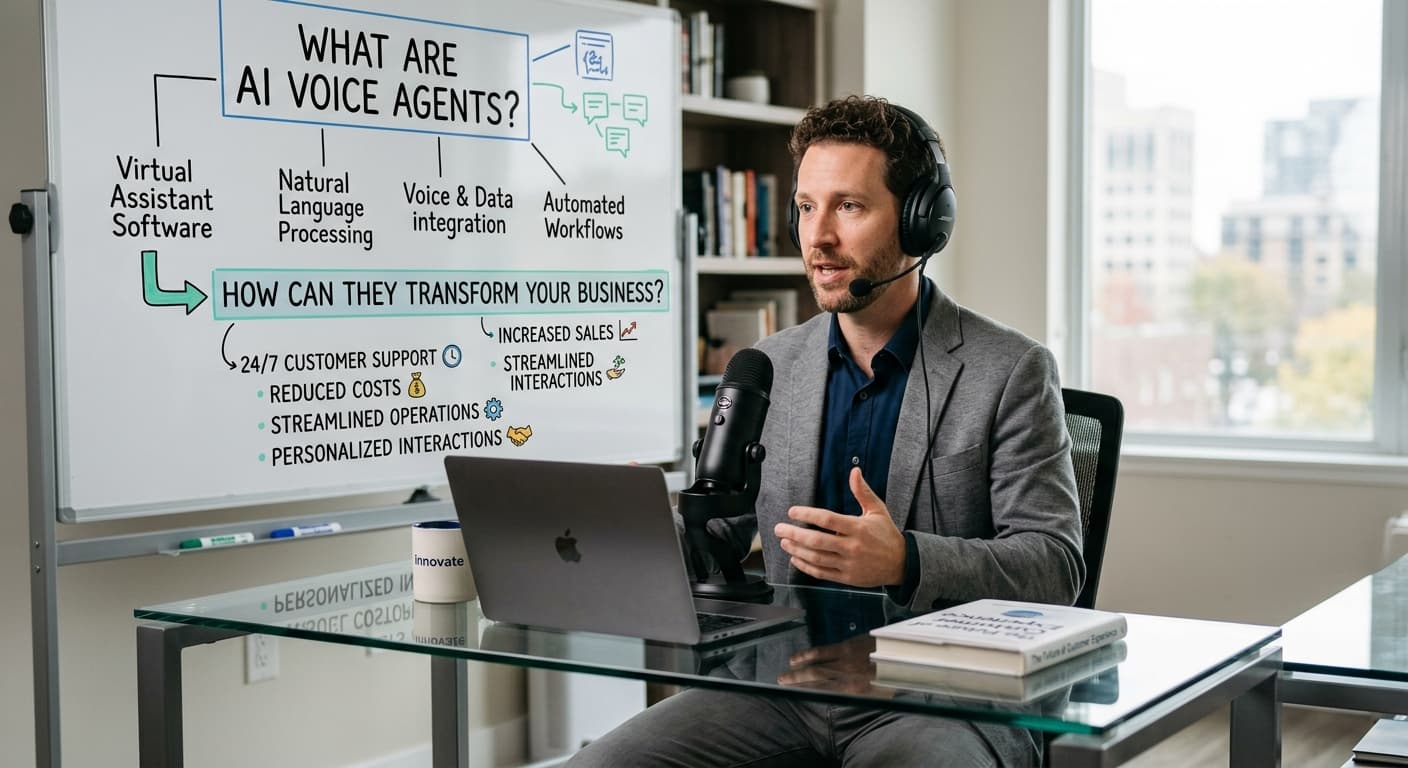
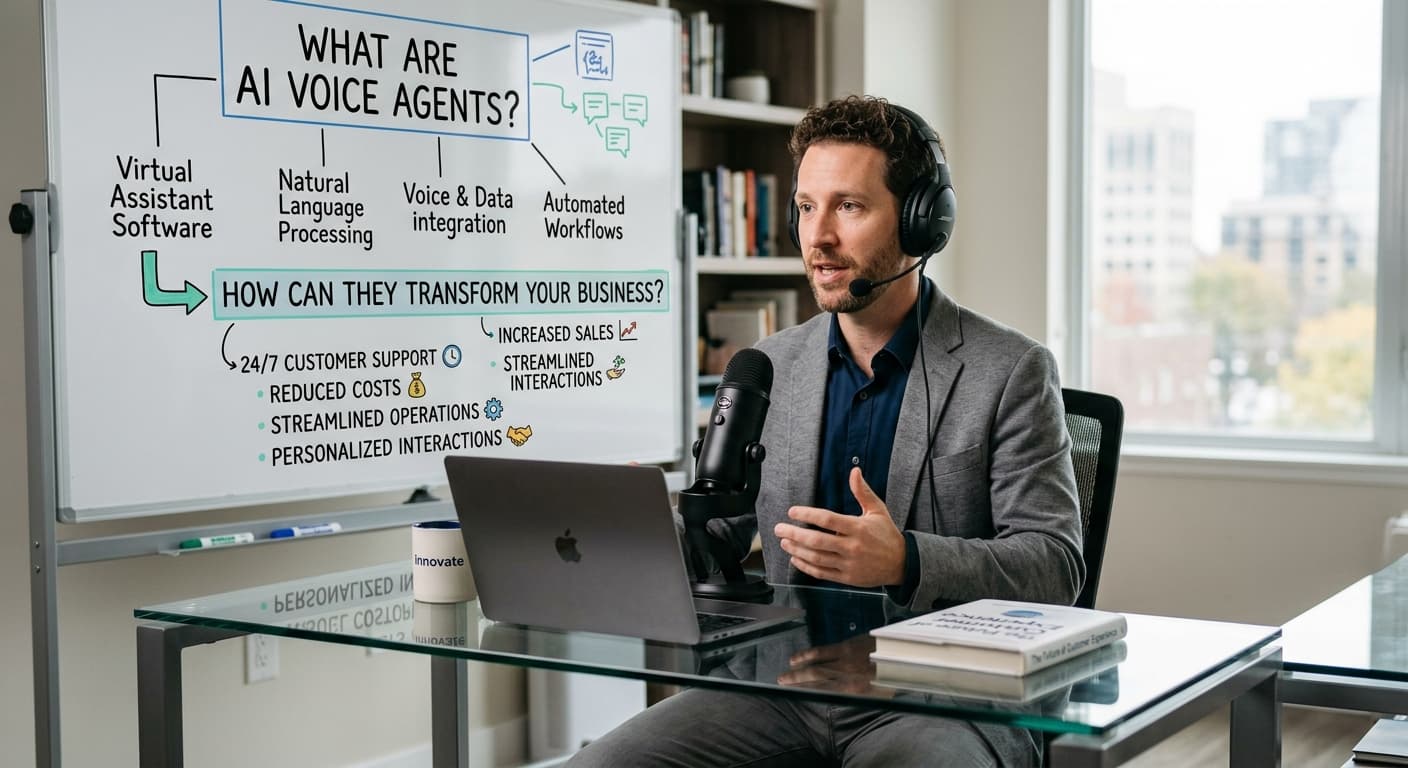
Call a support line at 11pm now and there's a decent chance you're talking to something that isn't a person, and isn't obviously a machine either. That's the whole point of AI voice agents: software that answers a phone call, understands what you're actually asking for, and replies in a voice that doesn't sound like it's reading a script written in 2004.
Under the hood, almost none of this is magic. Most production systems use a three-part pipeline: speech-to-text to turn your voice into words, a large language model to figure out what you meant and decide what to say back, and text-to-speech to turn that reply into audio again, a structure AssemblyAI has described as the standard architecture behind the current wave of voice AI. If you want the plain version of how the middle piece, the language model, actually works, How Does AI Work? A Beginner's Guide covers it without the marketing gloss.
Each of those three steps takes time. Add them up and you get the delay between when a caller stops talking and when the agent starts replying. Two hundred milliseconds feels natural. Eight hundred feels like a bad phone line. This is the entire reason some vendors are now building native speech-to-speech models that skip the text conversion step and go straight from audio to audio, trading some flexibility for a faster, more natural rhythm.
The line between a phone tree and an AI voice agent
Old-school IVR — "press 1 for billing, press 2 for support" — works by routing you through a fixed decision tree. It doesn't understand you. It matches a button press or, at best, a handful of keywords to a branch someone coded in advance. Say something the tree didn't anticipate and you get looped back to the main menu, which is why everyone hates it.
AI voice agents don't route, they converse. Say "I need to move my Tuesday appointment because my kid's sick" and a decent voice agent parses the intent, the date, and the reason in one pass, then asks the one clarifying question it actually needs. No menu, no tree, no "did you mean." That's the practical difference, and it's the reason businesses are replacing IVR layers instead of just upgrading them.
Here's the part that's easy to miss: replacing IVR is not the same as replacing your staff. The agents that work well are narrow on purpose. A voice agent handling tier-1 support resets passwords, checks order status, and books appointments; it hands off anything ambiguous or emotionally loaded. Treat it as a generalist and it will eventually say something confident and wrong to a customer who's already annoyed.
Where AI voice agents actually earn their keep in a business
Three use cases account for most of the real deployments right now, and they're not glamorous.
Tier-1 support that absorbs repetitive questions — order status, hours, password resets — so human agents only see the calls that need judgment.
Inbound appointment scheduling for clinics, salons, and service businesses, where the conversation is short, structured, and happens hundreds of times a day.
Outbound qualification calls that filter a lead list down to the people worth a human's time, running at a volume no call center floor could staff for.
Notice what's missing from that list: complex sales, escalated complaints, anything with legal or emotional weight. That's not a limitation to work around later. It's the correct boundary, and businesses that push past it tend to find out the hard way.
What this really costs (the part the sales page skips)
Ask a vendor "how much does it cost to build an AI voice agent" and you'll usually get a platform subscription number. That number is real but incomplete. You're actually paying four separate meters every time the phone rings: the telephony carrier fee for the call itself, the STT transcription cost, the LLM's token usage for every turn of the conversation, and the neural TTS cost to generate the spoken reply. Then the platform adds its own margin on top of some or all of that.
A short, scripted call — "confirm your appointment for Thursday, yes or no" — barely touches the LLM meter because there's almost nothing to reason about. A long outbound qualification call with branching questions and objection handling burns through far more tokens per minute, because the model is doing real work on every turn, not just pattern-matching. Two businesses running "an AI voice agent" can have wildly different total cost of ownership depending purely on how chatty the conversation design is, and almost no vendor puts that comparison in front of you before you sign.
The fix isn't complicated, it's just tedious: model your busiest call type start to finish, count the turns, and price out all four meters against your actual call volume before you commit to a platform. Anyone who tells you a flat per-minute price covers all of it is simplifying more than they should.
The failure mode nobody talks about: hallucination mid-call
Language models make things up. In a chat window that's an annoyance. On a live phone call with a customer who's about to give you a credit card number, it's a liability. This is the gap most articles about AI voice agents skip entirely, and it's the one that actually determines whether a deployment survives contact with real customers.
The practical mitigation is graceful fallback, and it needs to be designed in from the start, not bolted on later. Set a confidence threshold: if the model's tool call fails, or if it's asked something outside its scripted scope twice in a row, route to a human immediately instead of letting it guess a third time. Keep individual responses short — long, improvised answers are where hallucination shows up most, because the model has more room to drift from what it actually knows.
Worth being honest about: this doesn't get solved once and stay solved. Every prompt change, every new tool integration, reopens the question of what happens when it fails silently instead of failing loud. Teams that treat the human handoff as a permanent feature, not a temporary workaround, end up with fewer angry customers.
The compliance stuff that actually gets businesses in trouble
Two rules trip up more voice agent deployments than any technical bug does.
First, PCI-DSS. If your voice agent is ever going to hear a caller say their card number out loud, you have a problem, because the audio, the transcript, and any logs downstream now count as cardholder data. The common workaround is to route payment capture to a separate DTMF-based system — the caller keys in the number on their keypad instead of saying it — so the AI never processes the sensitive digits at all.
Second, TCPA, if you're running outbound calls in the US. Autodialing consumers without the right consent basis, or calling numbers on the do-not-call list, isn't a "we'll fix it later" problem. It's the kind of thing that turns into legal exposure fast, and an AI voice agent making ten thousand outbound calls a day multiplies the mistake by ten thousand before anyone notices the pattern.
Getting it plugged into the phone system you already have
Integration sounds like the scary part. It usually isn't. Voice agent platforms connect to telephony carriers through SIP trunking or providers like Twilio, and most of them ship pre-built connectors into common CRMs so a completed call automatically updates a record, logs a summary, or fires a follow-up task.
The part that actually goes wrong is quieter than that: field mapping drift. Your CRM's "appointment type" field gets renamed six months into using the tool, nobody updates the integration, and the voice agent starts booking appointments into a field that no longer exists in your reporting dashboard. Nobody notices until someone runs a report.
Which platform, and does it matter
Retell AI, PolyAI, Synthflow AI, Bland AI, Vapi, Cognigy, CloudTalk, and Lindy AI all show up as leading platforms in the current field, and Vellum's comparison of the space names several of them among the top options for customer support use. They differ mostly in how much conversation design flexibility they give you, how their pricing splits between the four cost meters above, and how deep their native CRM integrations go.
Picking one before you've modeled your own call flows and costs is backwards. The platform matters less than whether you understand what your specific conversation actually requires from it.
The technology behind AI voice agents is not the hard part anymore. Getting the boundaries right — what it's allowed to promise, when it hands off, what it's never allowed to hear — is where the real work still is, and that part doesn't come out of the box.
FAQ
How do AI voice agents differ from traditional IVR phone systems?
Traditional IVR routes callers through fixed menus using button presses or basic keyword spotting, with no real comprehension behind it. AI voice agents use language models to understand open-ended speech and hold context across a conversation, replying in natural sentences instead of forcing callers into rigid branches.
How does the underlying technology stack of an AI voice agent work?
Most systems chain three components: speech-to-text to transcribe the caller, a large language model to interpret meaning and generate a reply, and text-to-speech to voice that reply, a pipeline AssemblyAI has described as the industry standard. Newer platforms are experimenting with native speech-to-speech models that skip the text step for lower latency.
How much does it cost to build and deploy an AI voice agent?
There's no single figure, because you're paying four separate meters: telephony carrier minutes, STT transcription, LLM token usage, and TTS generation, plus the platform's own fee. A short scripted call and a long branching sales call will land in very different places on that same bill.
Can AI voice agents handle interruptions, strong accents, and background noise in real time?
Barge-in handling and accented-speech accuracy have both improved substantially, but neither is uniform across every accent or noise condition. Background noise, especially in cars or busy environments, remains a common cause of dropped or garbled turns, which is why a live human fallback path still belongs in every deployment.
How do voice AI agents integrate with existing phone systems and CRMs?
They connect to carriers through SIP trunking or providers like Twilio, and most platforms include pre-built CRM connectors to log calls and trigger follow-up workflows automatically. The integration itself is rarely the hard part; keeping field mappings accurate as your CRM changes is where teams tend to slip.