1. Introduction to Web Development Architecture
Modern web development has evolved far beyond basic script execution and static layouts. Today’s web ecosystems focus on creating reactive, real-time, and highly immersive experiences for users across global networks. This evolution has made a strategic choice of your underlying framework layers mandatory rather than optional.
Selecting an appropriate technical stack directly dictates your time-to-market, cloud resource costs, and future engineering scaling bounds. Whether you are building an agile minimum viable product (MVP) or an enterprise-grade platform, aligning your project specs with your team's specialized skills ensures software sustainability in 2025.
2. Frontend Technologies for Reactive User Interfaces
The frontend layer controls everything your end users interact with directly. In 2025, user-experience optimization centers around rendering efficiency, components reusability, and strong programmatic state control.
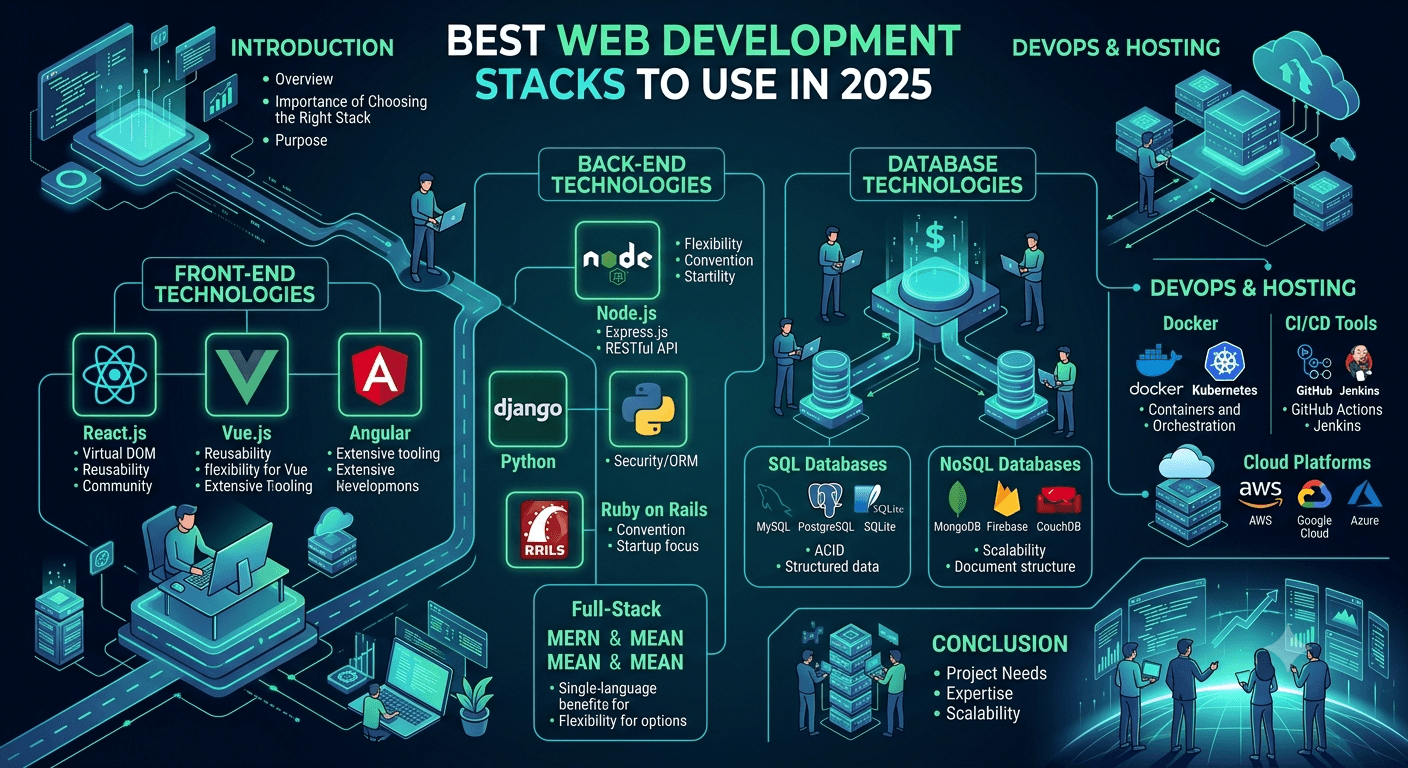
React.js: React continues to maintain its dominant position among web libraries. It relies on a Virtual DOM system for lightning-fast UI updates, boasts massive modular reusability, and utilizes a robust state-management ecosystem backed by Hooks and modern state containers like Redux or Zustand.
Vue.js: Favored for its progressive learning curve, Vue offers a highly flexible, lightweight framework architecture. It is an excellent choice for lightweight single-page applications (SPAs) and rapid mid-market iterations.
Angular: Backed by Google, Angular serves as a comprehensive, strictly structured framework. Its deep dependency injection, native TypeScript support, and enterprise tooling make it the default choice for large-scale corporate software systems.
3. Backend Technologies for Scalable Server Logic
A robust backend keeps data processing fast, coordinates server transactions smoothly, and secures application programming interfaces (APIs) against external vulnerabilities.
Node.js with Express.js: JavaScript-driven backend engineering continues to grow in popularity. Node’s asynchronous, non-blocking, event-driven I/O loop allows engineers to write frontend and backend logic in the same language. Express remains the gold standard for deploying lightweight, high-throughput RESTful APIs.
Django (Python): Known as the framework for perfectionists with deadlines, Django emphasizes rapid development and strict out-of-the-box security features. It offers built-in Object-Relational Mapping (ORM), robust cross-site scripting (XSS) protections, and integrated user authentication blocks.
Ruby on Rails: A mature, convention-over-configuration framework engineered to minimize developmental boilerplate code. Rails allows fast prototyping, offers strong community support, and remains a preferred choice for startups aiming to launch highly stable MVPs quickly.
4. Full-Stack JavaScript & Legacy Framework Bundles
Full-stack frameworks combine client-side interfaces and server configurations into a cohesive ecosystem. Using a unified language profile streamlines developer handoffs and unifies deployment steps.
MERN Stack (MongoDB, Express, React, Node.js): The MERN ecosystem provides complete architectural consistency. By utilizing JavaScript end-to-end, engineers can manage data storage, api logic, and interface rendering seamlessly. It is highly optimized for dynamic e-commerce solutions, real-time message rooms, and high-concurrency SaaS apps.
MEAN Stack (MongoDB, Express, Angular, Node.js): Operating similarly to MERN, this configuration replaces React with Angular on the client side. The MEAN stack provides an organized, prescriptive development approach well-suited for enterprise dashboards that require strict structural rules.
LAMP Stack (Linux, Apache, MySQL, PHP): As a classic foundational blueprint of web infrastructure, the LAMP stack remains highly dependable in 2025. It powers a massive share of web content through platforms like WordPress and Drupal, making it highly effective for server-side rendered applications and content management infrastructures.
5. Database Technologies for Structured & Scalable Data
Your application data layer must balance structural integrity with fast query retrieval speeds. Developers generally split their application environments into relational (SQL) or non-relational (NoSQL) databases based on their data architecture.
SQL Databases (MySQL, PostgreSQL, SQLite): These engines excel at managing highly structured datasets that rely on explicit relation mapping. PostgreSQL, in particular, offers advanced indexing capabilities, strong ACID compliance, and excellent support for complex multi-table queries.
NoSQL Databases (MongoDB, Firebase, CouchDB): NoSQL stores data in flexible, schematic JSON-like document layers. It provides exceptional scalability and schema flexibility, making it perfect for unstructured web data, user profiles, analytics platforms, and applications that iterate rapidly.
6. DevOps Workflows and Cloud Hosting Environments
A high-performing web application requires reliable deployment pipelines, robust cloud hosting, and automated infrastructure health checks to maintain top performance.
Docker and Kubernetes: Docker containerizes application codebases, guaranteeing identical runtime behavior across distinct local machine and cloud instances. Kubernetes orchestrates these container arrays, dynamically balancing traffic loads and scaling resources automatically to maintain platform uptime.
CI/CD Integration Pipelines: Automation servers like GitHub Actions, Jenkins, and GitLab CI run automated test configurations and manage build deployment steps smoothly, removing the risks of manual command-line deployments.
Cloud Infrastructure Giants (AWS, Google Cloud, Azure): Cloud platforms continue to provide scalable, highly available global hosting environments. Amazon Web Services (AWS) offers extensive infrastructure options; Google Cloud remains a top choice for AI integrations; and Microsoft Azure remains the leading platform for corporate and enterprise .NET configurations.
7. Conclusion & Engineering Action Plan for 2025
The web development space continues to evolve rapidly, driven by serverless optimization, microservices architectures, and advanced container workflows. While your project's explicit functional requirements should always guide your stack selection, JavaScript-centric toolchains like MERN remain exceptionally popular for creating fluid, modern web experiences. Concurrently, highly structured choices like Django and Angular continue to provide great security and scalability for data-dense corporate builds.
Ultimately, your ideal technology configuration will depend on your team’s expertise, project budget, and long-term scaling demands. Keeping your technical skills updated and monitoring industry benchmarks ensures your software platforms remain efficient, maintainable, and competitive throughout 2025 and beyond.