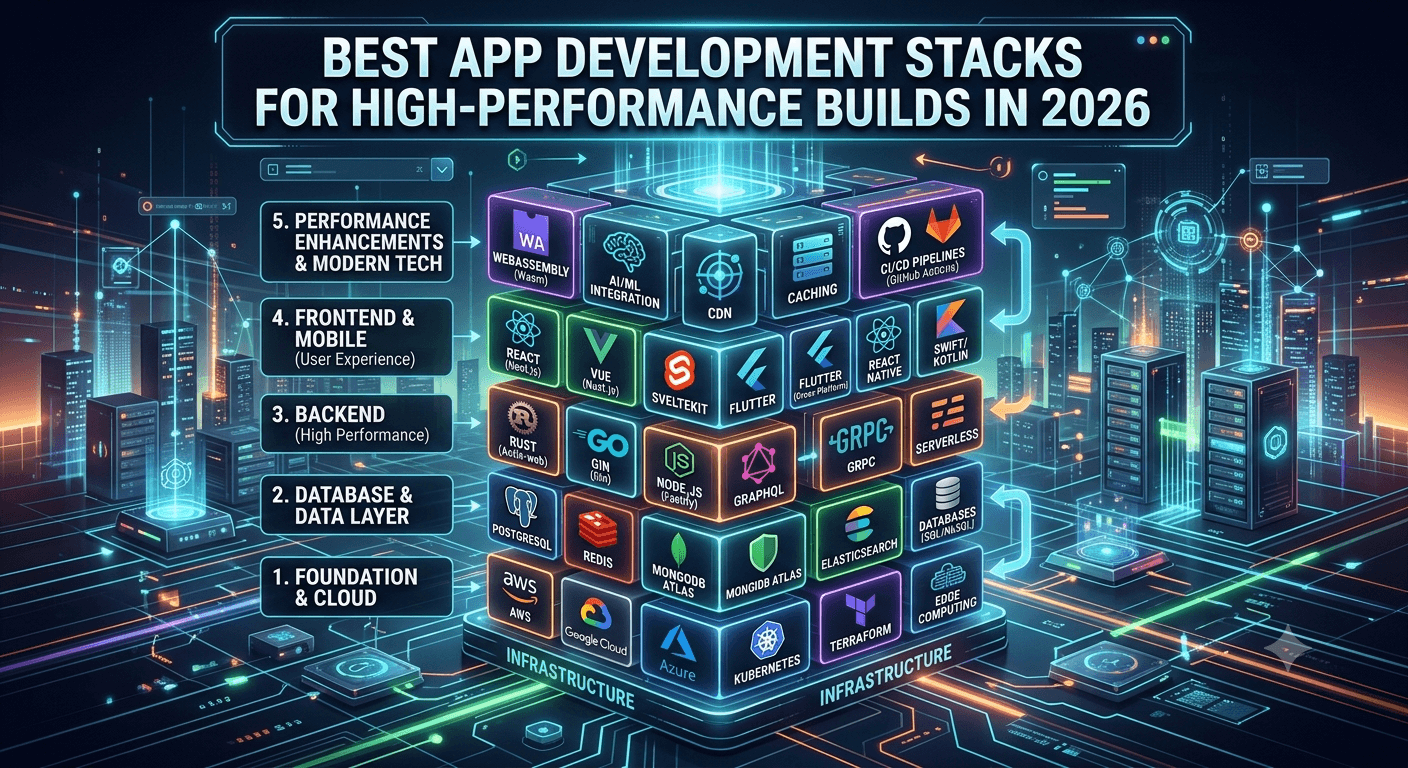
What is an App Development Stack?
Before choosing your frameworks, it is important to understand how an application stack operates. An app development stack is a unified combination of software components, libraries, and runtime environments working together to power a complete digital application. It is generally split into four major architectural layers:
Frontend Layer (Client-Side): The user interface (UI) and user experience (UX) layout engine that runs directly on the consumer's device.
Backend Layer (Server-Side): The internal core engine that handles database routing, secure user authentication, business logic, and API orchestration.
Database Layer: The structural storage hub where transaction logs, user records, and application data states are saved securely.
DevOps & Cloud Hosting Layer: The continuous integration pipelines, container managers, and server networks used to build, host, deploy, and secure your platforms.
1. React Native and Firebase for Agile Cross-Platform Apps
For engineering teams looking to hit the market quickly without maintaining separate codebases, the combination of React Native and Firebase remains an exceptional choice for cross-platform app development.
React Native utilizes JavaScript and TypeScript to render native UI modules across both Android and iOS devices from a unified codebase. This reduces development timelines significantly. When paired with Firebase's suite of serverless backends, engineering teams gain instant access to real-time NoSQL databases (Firestore), plug-and-play user authentication protocols, cloud file storage, and automated push notification services right out of the box.
2. Flutter and Firebase for High-Performance Cross-Platform Apps
When your mobile application relies heavily on complex custom visuals, smooth animations, and top-tier frame rendering, Flutter paired with Firebase offers an excellent cross-platform alternative.
Built by Google using the Dart language, Flutter bypasses traditional system bridges by compiling directly to native ARM machine code. This architecture gives your application a noticeable boost in UI performance and responsiveness. Utilizing Flutter’s rich, customizable widget catalog alongside Firebase’s Realtime Databases and Cloud Functions allows startups to scale their applications dynamically while keeping cloud compute overhead to a minimum.
3. SwiftUI and Vapor for Native iOS Ecosystems
For development teams focusing entirely on the Apple ecosystem, building a native application using SwiftUI combined with a Swift-driven backend like Vapor provides an incredibly fast and integrated user experience.
SwiftUI features a clean, declarative layout syntax that lets engineers build responsive user interfaces with minimal code. By keeping the server-side logic in the same language with the Vapor framework, iOS engineers can handle both client-side views and backend API routing using Swift. This shared code environment simplifies data validation, lowers system latency, and optimizes memory management on Apple hardware.
4. Kotlin and Jetpack Compose for Native Android Architecture
For projects dedicated strictly to the Android ecosystem, the modern industry standard centers around Kotlin paired with Jetpack Compose for the UI layer, alongside robust systems like Spring Boot or Ktor on the backend.
Kotlin is the official language endorsed by Google for Android development, offering a modern, concise syntax that prevents common runtime bugs like null pointer exceptions. Jetpack Compose simplifies UI engineering by utilizing an intuitive, declarative programming model. Driving server logic via Ktor or Spring Boot enables high-performance asynchronous execution, making this stack ideal for building data-heavy mobile applications.
5. Next.js and Node.js for SEO-Optimized Web Applications
Web applications designed to capture organic search traffic need to prioritize fast load times, excellent Core Web Vitals, and flawless search engine crawlability. The combination of Next.js and Node.js is custom-built for these requirements.
Next.js enhances standard React apps by providing native Server-Side Rendering (SSR) and Incremental Static Regeneration (ISR). This architecture ensures that Google crawlers receive fully rendered HTML instantly, boosting your indexing potential. Running your server infrastructure on Node.js using NestJS or Express allows you to handle massive API request volumes with minimal event-loop blockages.
6. Django and React for Scalable Full-Stack Web Development
When a project requires advanced data security, rapid feature iteration, and a highly dynamic dashboard interface, pairing Django with React creates an incredibly reliable full-stack ecosystem.
Django operates on a "batteries-included" philosophy, providing an integrated administration panel, a robust Object-Relational Mapper (ORM), and native protection against common vulnerabilities like SQL injection and cross-site scripting (XSS). Connecting this secure backend to a React frontend gives you the best of both worlds: robust server security combined with a highly interactive, component-driven client interface.
7. Golang and Vue.js for Real-Time, High-Performance Web Apps
Applications that process thousands of simultaneous data streams—such as live financial charts, instant chat apps, or collaborative editing tools—require an ultra-fast backend. Combining Golang with Vue.js excels in these environments.
Go (Golang) is engineered for highly efficient concurrency, utilizing lightweight goroutines that handle massive web traffic with very little CPU overhead. Pairing this fast data processing with Vue.js gives your users a highly responsive experience. Vue’s lightweight, fast-rendering virtual DOM makes it easy to bind live server data directly to your frontend UI elements.
8. Laravel and Vue.js for Reliable, PHP-Driven Web Apps
For software startups and medium-sized businesses looking to build web applications with established, highly maintainable structures, the classic combination of Laravel and Vue.js remains an industry favorite.
Laravel simplifies standard backend engineering by providing elegant, built-in systems for database migrations, user authentication, and route handling. Vue.js integrates smoothly with Laravel's blade template engine via Inertia.js, allowing developers to build interactive single-page application interfaces without the complexity of managing an isolated API system.
9. ASP.NET Core and Angular for Complex Enterprise Applications
Large-scale corporate environments require strict type safety, predictable maintainability, and deep compliance architectures. ASP.NET Core paired with Angular is the leading choice for these enterprise scenarios.
Angular provides a strictly organized framework structured entirely around TypeScript, ensuring codebase consistency across large engineering teams. On the server side, Microsoft’s open-source ASP.NET Core framework delivers phenomenal execution speeds, multi-platform stability, and deep optimization for enterprise database systems like Microsoft SQL Server and Oracle.
10. Serverless Architecture via AWS Lambda and DynamoDB
For modern engineering teams looking to eliminate the time and cost of manual infrastructure management, adopting a fully serverless stack using cloud computing tools like AWS Lambda and DynamoDB is a powerful strategy.
In a serverless configuration, your backend code is broken down into microservices that execute purely on-demand, scaling automatically to handle traffic spikes and spinning down to zero when inactive. Storing your application data in a distributed NoSQL database like Amazon DynamoDB guarantees predictable, single-digit millisecond latency at any scale. This setup allows your team to focus entirely on optimizing client-side interfaces using React, Vue, or Angular without ever configuring an underlying operating system server.
Strategic Checklist: How to Choose Your Ideal Tech Stack
To select the absolute best technology stack for your specific digital product, evaluate your project goals against these five core engineering factors:
Functional Project Scope: Match your framework's capabilities with your application's unique requirements. Avoid over-engineering a simple internal business tool with complex enterprise systems, and avoid building massive corporate software on a lightweight MVP stack.
Development Velocity: If hitting the market quickly is your highest priority, choose ecosystems that emphasize out-of-the-box features, such as Firebase integrations or the Django framework.
Future Scaling Constraints: Projects that expect massive traffic growth from day one should look toward highly concurrent backend environments like Golang, or cloud-native serverless systems like AWS Lambda.
Team Skill Alignment: Leverage your engineering team's current expertise. Writing an application using languages your developers already know reduces onboarding friction and prevents costly design errors.
Security & Compliance Standards: Financial systems and healthcare applications require robust, enterprise-grade validation tools. Stacks like ASP.NET Core or Spring Boot provide the advanced security compliance these industries demand.
Conclusion
Ultimately, the ideal application development stack depends entirely on your specific project type, budget bounds, and long-term scaling targets. As we move through 2025, cross-platform UI engines like React Native and Flutter will continue to lead mobile development, while performance-focused stacks like Next.js, Django, and Golang will power modern web platforms.
By matching your business goals with the right technology stack, you guarantee a scalable, maintainable, and high-performing application. If you are looking for expert software consulting to find the perfect stack for your next project, feel free to contact us for a professional architecture audit today!