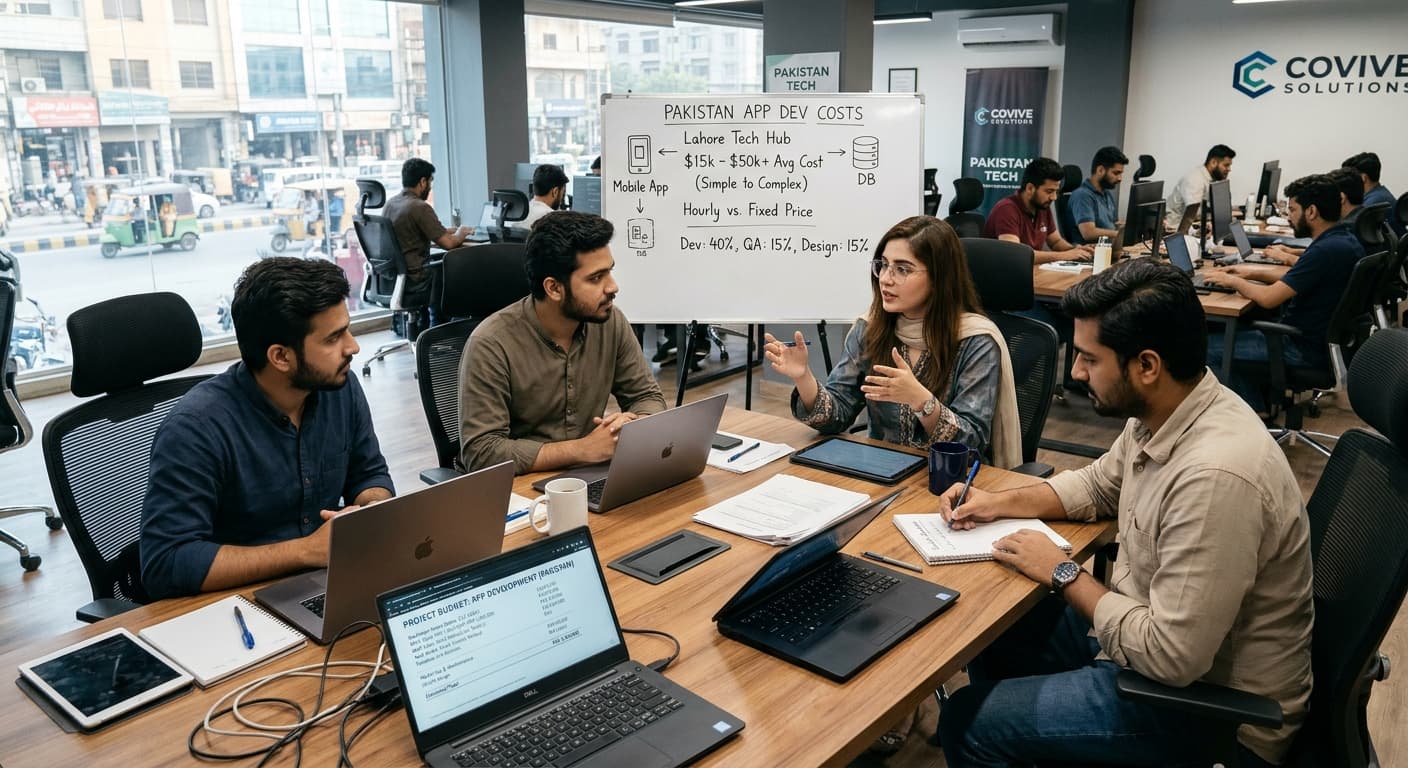
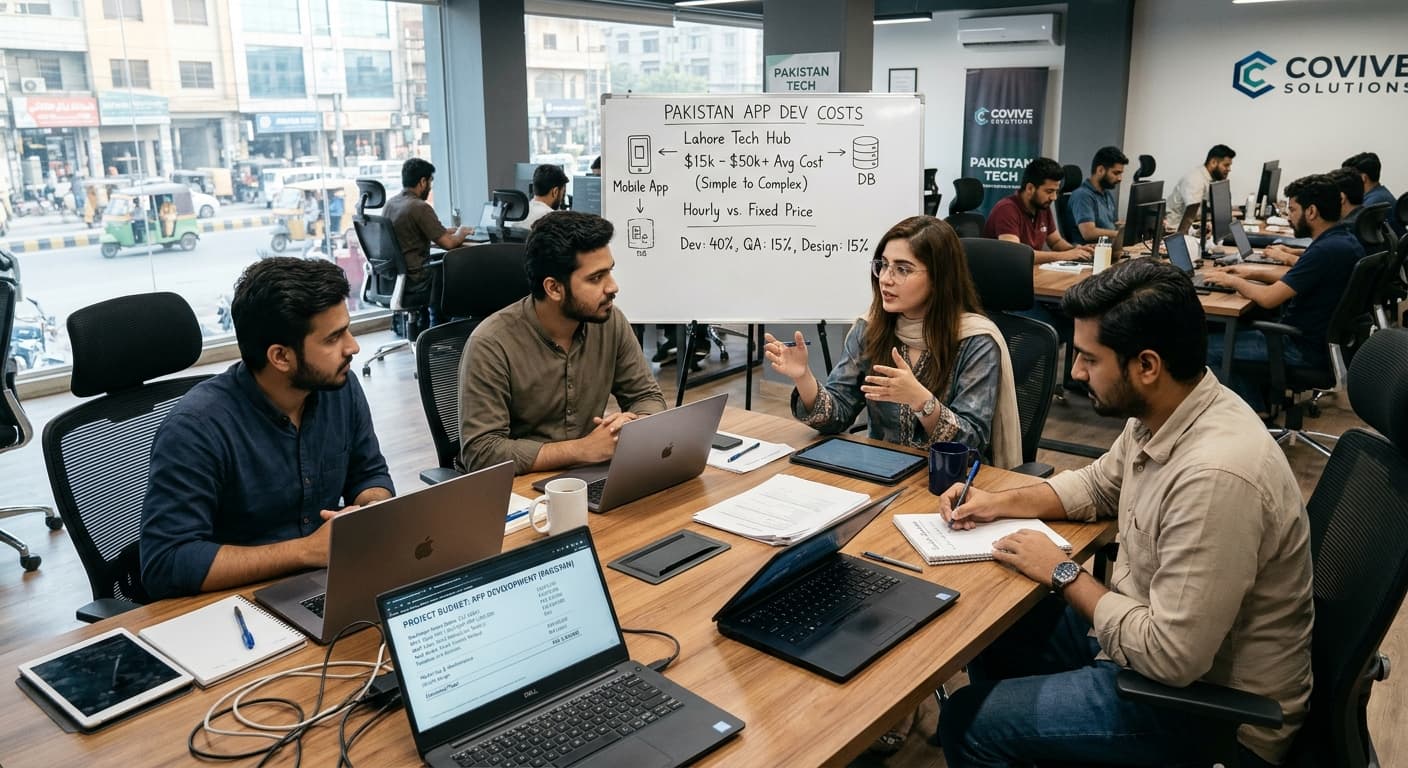
What actually drives App Development Cost in Pakistan
A basic app in Pakistan costs somewhere between $2,000 and $8,000. A mid-complexity app with a custom backend and user accounts runs $8,000 to $25,000. Anything approaching an on-demand service platform, a fintech product, or a multi-vendor marketplace starts at $25,000 and has no real ceiling. The App Development Cost you land on depends less on how fancy the idea sounds and more on three unglamorous things: how many screens need custom logic, whether the backend talks to other systems, and how many platforms you're building for at once.
Here's the part most first-time founders miss. Two apps that look identical to a user can cost four times apart to build, because one pulls live data from three APIs and the other doesn't. The interface is the cheap part. The plumbing underneath it is where the hours go.
The factors that move the number
Platform choice matters more than people expect. A single native app (iOS or Android only) costs less than a cross-platform build in Flutter or React Native, but cross-platform still beats building two separate native apps by 30-40%. If you need both iOS and Android from day one, cross-platform is almost always the sensible call unless you need deep hardware access.
Backend complexity is the other big lever. A simple app with Firebase and a handful of screens needs maybe 150-200 development hours. An app with a custom API, admin dashboard, payment gateway, and push notifications can run 600-900 hours before you've touched polish. Multiply that by the hourly rate for app developers in Pakistan and you'll see where quotes start to spread apart.
Hourly rates vs fixed-price quotes
Pakistani developers typically bill between $12 and $40 an hour, depending on seniority and city. A junior developer in Lahore or Faisalabad might sit at $12-18. A senior engineer at a firm working with US or UK clients can bill $30-40. Karachi and Islamabad agencies with international portfolios often sit at the top of that range, while smaller cities and solo freelancers undercut it substantially.
Fixed-price contracts are more common for smaller apps with a defined scope. Hourly billing shows up more on apps where requirements will shift, which is most apps, if founders are honest about it. Ask for a fixed price on the MVP and hourly billing on everything after launch — it protects both sides when the scope inevitably grows.
App type | Typical cost (USD) | Typical timeline |
|---|
Basic app (static content, simple forms) | $2,000 - $8,000 | 4-6 weeks |
Mid-complexity (accounts, custom backend, notifications) | $8,000 - $25,000 | 8-14 weeks |
On-demand / marketplace / fintech | $25,000 - $80,000+ | 4-8 months |
Enterprise integration (ERP, custom hardware, compliance) | $50,000+ | 6+ months |
The quote on the first proposal rarely reflects the app development price in Pakistan once scope changes and third-party fees get added mid-project. Budget 15-20% above the initial estimate as a contingency, not because agencies are dishonest, but because almost no project ships with the exact feature set it started with.
The costs nobody puts in the first quote
App store fees, SSL certificates, third-party API costs (maps, SMS gateways, payment processors), and push notification services are rarely itemized up front. They're small individually — $99 a year for Apple's developer account, a few cents per SMS — but they add up, and they're recurring, not one-time. This is the same pattern covered in detail in Hidden Website Costs in Pakistan: What Agencies Don't Tell You Upfront, and it applies just as much to apps as to websites: the build quote and the real bill are two different documents.
Design revisions are another quiet cost driver. Most agencies include two or three rounds of design feedback in the base price. Round four onward often gets billed separately, and nobody mentions this until round four arrives.
What happens after the app ships
Launch is not the finish line, whatever the proposal implies. Operating systems update twice a year, and apps that aren't tested against new iOS and Android releases start breaking within 12-18 months. Budgeting for ongoing upkeep is as real a line item as the initial App Development Cost, and it's worth reading how this plays out for websites in Website maintenance cost in Pakistan — the logic transfers almost directly, just with app store review cycles added on top.
A reasonable annual maintenance budget is 15-20% of the original build cost. An app that cost $15,000 to build should expect $2,200-$3,000 a year in upkeep, covering OS compatibility, bug fixes, and minor feature tweaks. Skip this and the app doesn't crash dramatically — it just slowly stops working on newer phones until users notice and stop opening it.
Picking an app development company in Pakistan without guessing
Rates alone don't tell you much. An app development company in Pakistan charging $15 an hour with a bloated timeline can cost more in total than one charging $30 an hour that ships in half the time. Ask for a breakdown by feature, not just a lump sum, and ask what's excluded — that single question surfaces most of the costs that would otherwise show up as a surprise invoice in month three.
The agencies worth hiring will tell you where your idea is overbuilt before you pay for it. That's usually a better signal than the number on the first page of the proposal.
Frequently asked questions
Can I get a working app built for under $2,000 in Pakistan?
Yes, but it will be a basic MVP with one or two core features, built on a template framework, with minimal testing. Anything involving custom backend logic, payment integration, or real-time features will push past that number quickly.
Do Pakistani agencies charge in dollars or rupees?
Most mid-size and larger agencies quote in USD, especially if they work with international clients, since rupee volatility makes long-term rupee contracts risky for them. Smaller local shops serving Pakistani businesses often quote in PKR directly.
Is it cheaper to hire a freelancer instead of an agency?
Usually yes on the invoice, but you take on project management yourself and lose the backup of a team if the freelancer disappears mid-project. For anything beyond a simple app, a small agency with 3-5 people tends to be the safer bet even at a higher rate.
How much should I budget for maintenance after launch?
Plan for roughly 15-20% of the original build cost per year for updates, bug fixes, and OS compatibility changes. This is separate from hosting and API fees, which run on their own schedule regardless of how much you use the app.
Why do two agencies quote wildly different prices for the same app idea?
One is usually pricing the MVP you described, and the other is pricing the app they think you actually need once they account for scale, security, and edge cases. Ask both for a feature-by-feature breakdown before deciding which number means anything.