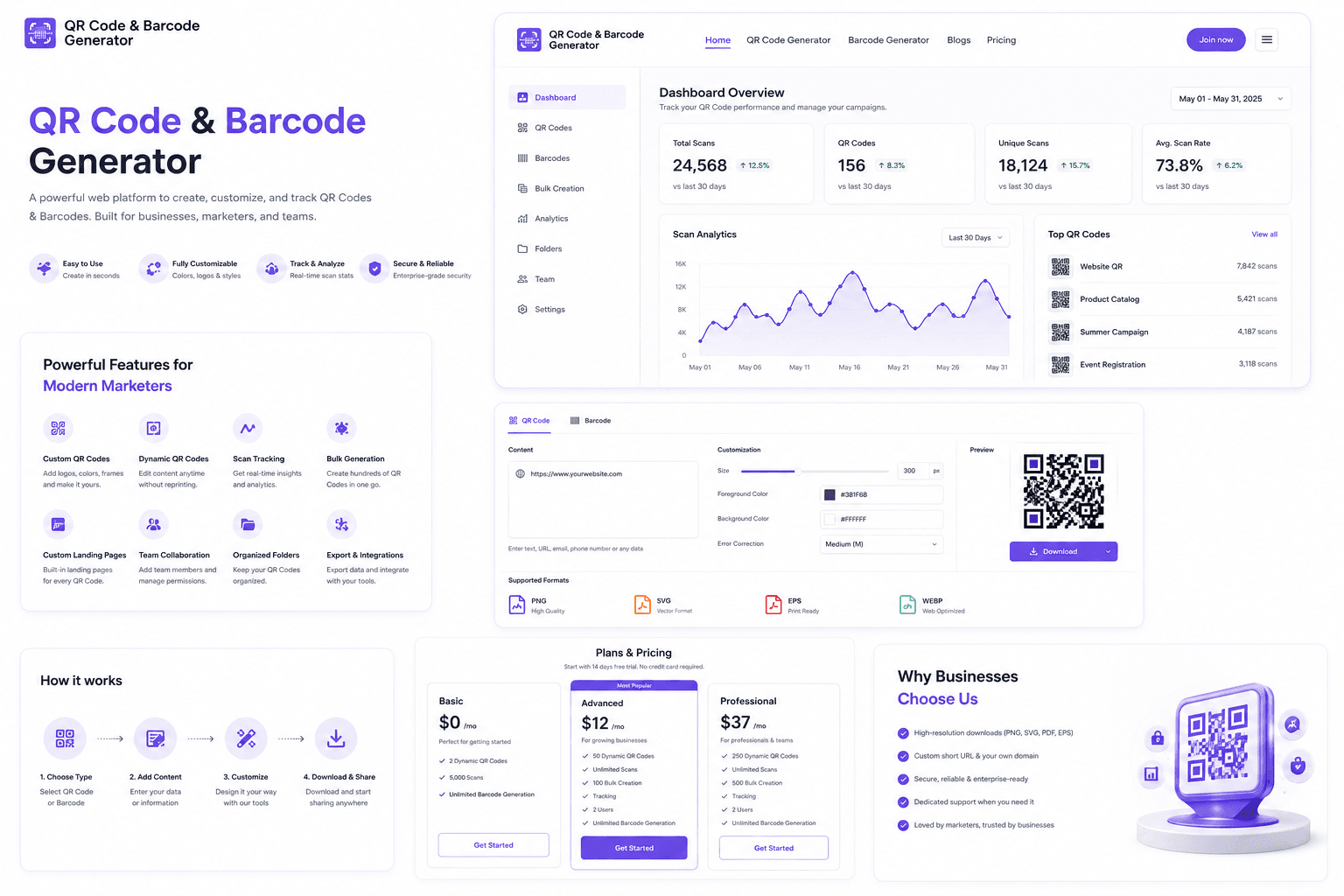
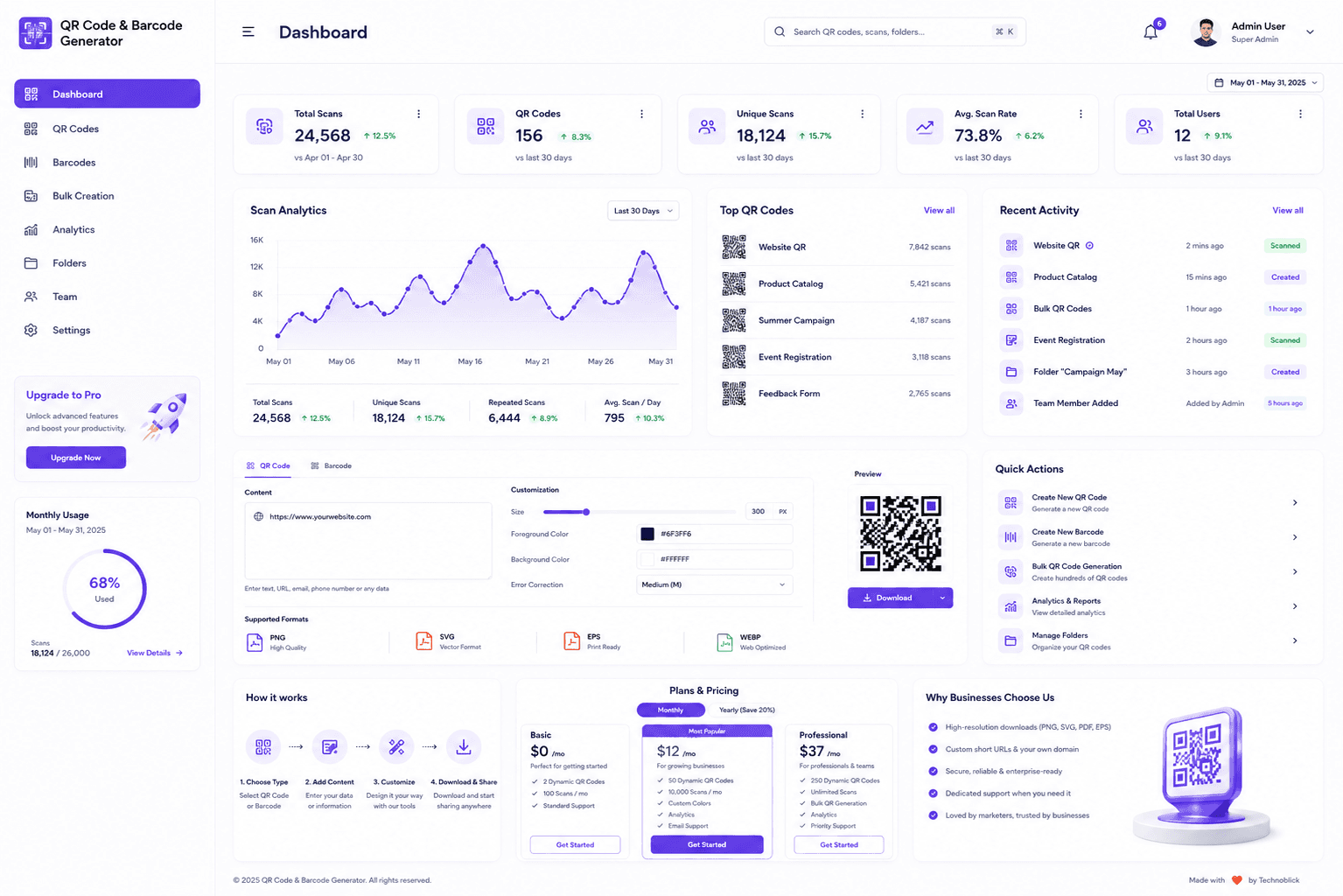
Overview
Generating a QR code is not a product, it's a library call. QrVertex was built around what happens after the scan.
A QR generator that only generates has no business, that feature is available free in every language, offered by dozens of sites that will do it in a browser tab and never charge for it. The product begins immediately after the scan, who scanned it, where, when, and what happened next, information a restaurant, retailer, marketing team or events company actually wants, and the part that's genuinely hard to build. QrVertex was built around that distinction from the first architecture decision.
Challenge
Every feature at the generation end is available free elsewhere, so any product competing on generation alone is competing with zero, and losing, the value has to sit somewhere free tools structurally can't reach. Scans happen in the physical world too, a code on a printed menu or shop window is scanned by someone standing somewhere real, and the system has to capture that context in the fraction of a second before redirecting them, without making them wait. The redirect speed is the sharpest constraint in the whole product, a scan should feel instant, because a QR code that hesitates gets abandoned and the physical asset it was printed on becomes worthless. Printed codes are also permanent while destinations aren't, a code on ten thousand printed menus can't be changed, but the destination it points to might need to be, and that gap is exactly where dynamic codes earn their value. And analytics volume grows unevenly, one customer with a poster campaign can generate more scan events than a hundred casual users combined, so the data layer has to handle spiky volume rather than a smooth curve.
Approach
The team architected around the redirect, not the generator, generation was straightforward and treated as such, while engineering attention went to the scan path, capturing context, recording the event, and redirecting fast enough that the user perceives nothing between raising their phone and landing on the page. Tracking was built as a side effect that never delays the redirect, the user's experience and the customer's analytics are decoupled by design, since the moment tracking starts costing milliseconds visible to the person scanning, the product has damaged the asset it was meant to measure. Analytics were designed around the questions customers actually ask rather than a raw event log, where are people scanning, when, is the poster campaign working better than the flyer, and the schema was built to answer those directly.
Result
QrVertex is a live platform generating codes and tracking scans in production, with analytics as the product rather than an add-on, the differentiator that separates it from free generators. Specific figures for codes generated, scans tracked and active users are available on request.